Uncategorized

“Hollywood Thought The Princess Bride Was Unfilmable – What Happened Next Is Pure Magic”
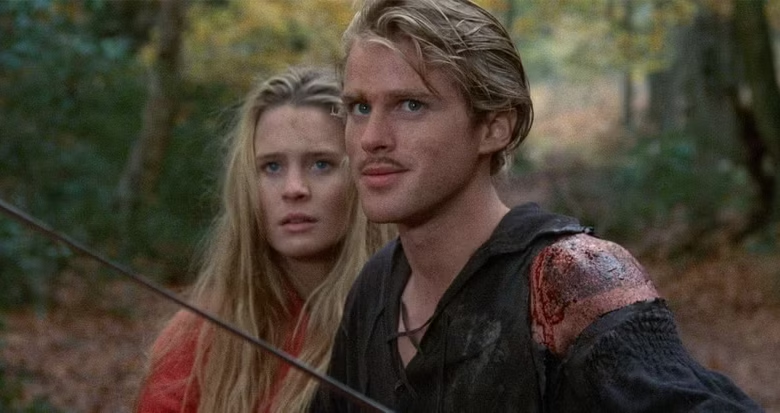
In 1987, The Princess Bride arrived in theaters and almost nobody came.Hollywood didn’t know what to do with it. Was it a fairy tale? A parody? A romance? A swashbuckling adventure? A comedy? The executives kept asking the question, and the answer was always: yes. All of those things. Simultaneously. Sincerely.That was the problem.In 1987, Hollywood needed to put a movie in a neat box to market it. The Princess Bride refused every box it was offered. The trailers were confused. The marketing was muddled. Audiences stayed home—or went to see it and left unsure what they had just watched. The film made roughly $30 million on a $16 million budget.
Technically profitable. Practically a disappointment.Director Rob Reiner was crushed. He had fought for this film and believed in it deeply. Author William Goldman—who wrote the original novel in 1973 and the screenplay—feared his favorite story might fade away forever.It had already taken a miracle to get it made.Goldman’s novel, published in 1973, was immediately beloved by readers. It was witty and sincere, a fairy tale that knew it was a fairy tale, a satire that genuinely meant everything it was satirizing. It held humor and heartbreak in the same hand without dropping either.Hollywood looked at it and declared it unfilmable.
Too tonally shifting. Too hard to categorize. Too resistant to the simple elevator pitch that gets movies greenlit. For fourteen years, studios passed.Then Rob Reiner read the screenplay. Coming off major successes like This Is Spinal Tap and Stand by Me, he had the clout to get it made. But Reiner understood something crucial: the tonal balance Goldman had achieved—funny and sincere, satirical and genuinely romantic, aware of fairy tale conventions and fully committed to them—was the entire point. Destroy that balance and you lose everything.The casting had to be perfect.Cary Elwes, just 24, read the script and understood immediately. Westley had to be played with complete sincerity and a twinkle in his eye at the same time. He had to mean every romantic word while being slightly in on the joke, never letting you see the seam. The chemistry with Robin Wright was instant and real.Wright was only 20 when she filmed the movie. She brought to Buttercup a complete commitment to the character’s earnestness that Goldman hadn’t been sure was possible. When he first saw her on set, Goldman reportedly whispered, “That is exactly what I imagined.”Then there was Mandy Patinkin as Inigo Montoya. What most audiences don’t know is what Patinkin was actually doing in that legendary scene. His own father, Lester Patinkin, had died of pancreatic cancer in 1972 when Mandy was nineteen. Fifteen years later, delivering the line “Hello. My name is Inigo Montoya. You killed my father. Prepare to die,” Patinkin wasn’t just acting. He was speaking to cancer. “I was Inigo,” he later said. “I was killing the cancer that had killed my father.”And then there was André the Giant.By the time of filming, André’s acromegaly had severely damaged his body. His spine was deteriorating and simple tasks caused him significant pain. When the script called for Fezzik to carry Buttercup, André couldn’t lift Robin Wright safely, so she was suspended on wires.
The scene you see—effortless strength—was carefully staged to protect André’s dignity while he smiled through the pain. There isn’t a single behind-the-scenes photo from the set where André isn’t smiling.The sword fight between Westley and Inigo is six minutes of pure cinematic joy. Both actors trained for weeks with legendary sword master Bob Anderson, performing the entire sequence themselves. When they first showed Reiner the choreography, he said it was great—but too short. They went back and made it even better.Billy Crystal’s Miracle Max scene was supposed to be brief. Instead, Reiner let him improvise for hours. The cast and crew were in hysterics. Reiner kept leaving the set because he couldn’t stop laughing. Patinkin bruised a rib trying not to break character. From days of chaos and uncontrollable laughter, they extracted five minutes of comedy gold that people have been quoting for nearly forty years.
The production wrapped with the quiet sense that something special had been created. Then the movie opened… and almost nobody came.Home video changed everything.Slowly, personally, one conversation at a time. Families rented it on VHS, loved it, and told others. Parents showed it to children. Children showed it to friends. College students quoted it in hallways. The film grew through love, not marketing.By the early 1990s, The Princess Bride had become a genuine classic—not because of box office or awards (it received just one Oscar nomination), but because ordinary people made it part of their lives.
They passed it forward. They shared it with their children. They used its lines as cultural shorthand and “As you wish” as a secret code for “I love you.”In 2020, when the original cast reunited for a Zoom reading during the pandemic, the event raised over $4 million. Thirty-three years after it barely broke even in theaters.The Princess Bride is a film about the importance of stories. The frame narrative of a grandfather reading to a skeptical grandson is the key. By the end, the boy—who didn’t want a story—asks for a little more. And the grandfather replies, “As you wish.”It is the story of a skeptical audience falling in love with a tale anyway.A film that Hollywood didn’t know how to sell became one of the most emotionally significant pieces of popular culture of the last fifty years—loved into immortality by ordinary people, by Mandy Patinkin speaking to his father through revenge, by André the Giant smiling through pain, by Reiner laughing until he cried, and by millions of families who made it their own.“As you wish.”It means: I love you.The movie always meant that too.And it always will.