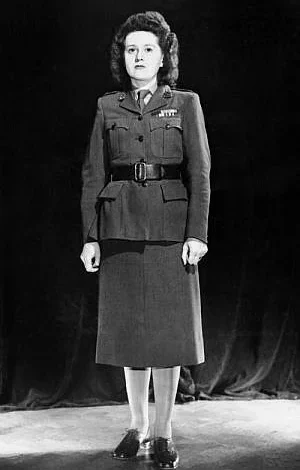
The Gestapo tortured her and sentenced her to death, but she never gave away a single name.Odette Sansom was a mother of three living a quiet life in Somerset, England. In 1942, she could have stayed safely at home with her children and waited for World War II to end.But she couldn’t do that.Born in France, Odette wanted her daughters to grow up free.
So she chose to fight.When the Special Operations Executive — a secret organization created by Winston Churchill — called for volunteers who could blend into occupied France, Odette said yes. She left behind her safe home and family to become a spy, fully aware of the extreme danger.She operated under the codename “Lise.”Working alongside Peter Churchill, Odette supported the French Resistance by gathering intelligence and assisting sabotage operations in southeastern France. For months, they secretly relayed information between the British and the French underground. Then, in April 1943, they were betrayed to the Gestapo.The interrogation began with questions.
The Gestapo believed everyone would eventually break. As hours turned into days, their patience ran out. They wanted names, safe house locations, and ways to dismantle the Resistance.When Odette refused to speak, the torture began. The Gestapo pulled out her toenails and burned her back with a hot iron. A Nazi officer demanded, “Give us the names of your contacts, or you will never see daylight again.”Odette looked at him calmly and replied, “I have nothing to say to you. You can hurt my body, but you cannot make me betray my friends or my country.”They sentenced her to death, but she remained silent. During her interrogation, she cleverly claimed that Peter Churchill was her husband and related to the British Prime Minister. This lie convinced the Gestapo they might be valuable hostages.Because she refused to break, Odette saved the lives of many Resistance members.She was sent to Ravensbrück concentration camp for women and marked as “Night and Fog” — a designation meant to make her disappear without a trace.
She spent over a year in a dark cell, enduring hunger, illness, and brutal conditions, but she never gave up.When the war ended in 1945, the camp commandant, Fritz Suhren, tried to use Odette as a shield. Believing she was connected to Winston Churchill, he hoped she would save him from punishment. Instead, when they reached the American lines, Odette pointed at him and said, “This man is the camp commandant. He is a war criminal. Arrest him.”In 1946, Odette Sansom Hallowes was awarded the George Cross for her extraordinary bravery. In 1951, a thief stole her medal during a burglary. After her story appeared in the newspapers, the thief returned it with a note of apology.Odette died in 1995 at the age of 82. She never considered herself a hero — only someone who did what had to be done.Her story is a powerful reminder that even under the worst torture, a person can remain true to what is right. Sometimes, simply saying “no” is the bravest act of all.