“His Legs Were Frozen After 6 Hours in the Titanic Ocean – He Refused Amputation and Became a Tennis Champion”

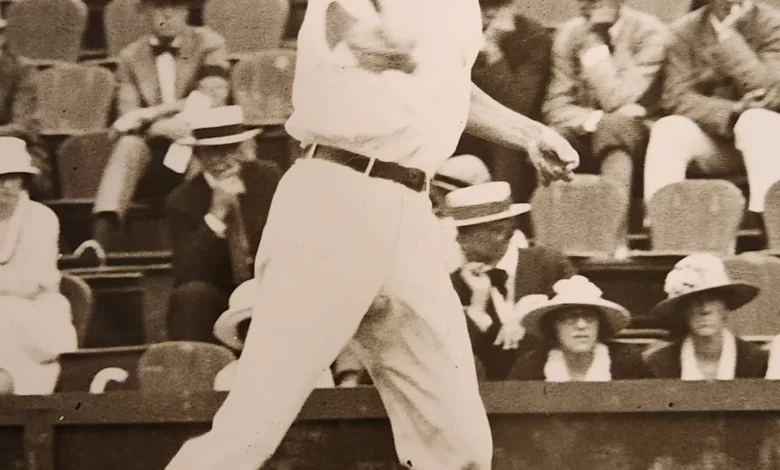
On the night of April 14, 1912, a twenty-one-year-old Harvard freshman named Richard Norris Williams watched his father die.His father, Charles Duane Williams, was a prominent American lawyer living in Geneva. The two were traveling together to Pennsylvania so Richard could enroll for the spring term. They had boarded the RMS Titanic in Cherbourg as first-class passengers. When the ship struck the iceberg, they stayed together on deck. As the Titanic sank, the forward funnel collapsed, crashing into the water and killing his father instantly.
Richard, standing right beside him, narrowly escaped the same fate.He entered the freezing North Atlantic as the ship went down. The water temperature was approximately twenty-eight degrees Fahrenheit. In such cold, an unprotected person was expected to survive only minutes. Richard spent nearly six hours swimming or clinging to a partially submerged collapsible lifeboat. When the Carpathia rescued him at dawn on April 15, his legs were frozen from the knees down.The ship’s surgeon took one look and delivered the only verdict possible in 1912: the legs would have to be amputated. Gangrene was a near certainty. The operation was scheduled.Richard refused.He told the doctors he was going to need his legs.
Against all medical advice, he got off the cot and started walking. For the entire four-day voyage to New York, he forced himself to walk the decks of the Carpathia every two hours, day and night. Each step was pure agony, but he never stopped. By the time the ship reached New York Harbor, his legs were saved. He walked off the gangway on his own.There was another detail from that night that Richard rarely spoke about. As the ship was sinking, he had kicked down a locked cabin door to free a trapped passenger. A White Star Line steward threatened to report him for destroying company property. Richard kicked the door down anyway.He enrolled at Harvard that fall. Just nine weeks after the disaster, he entered a tennis tournament.
One of his early opponents was Karl Behr — another Titanic survivor. Williams lost that match, but he kept playing.In 1914, at age twenty-three, he won the U.S. National Singles Championship (the future U.S. Open). He won it again in 1916. Over the following years, he claimed multiple U.S. doubles titles and became one of the top-ranked tennis players in the world.He served in the U.S. Army during World War I and was awarded France’s Croix de Guerre and Legion of Honor. After the war, he returned to tennis and continued competing at the highest level.At the 1924 Paris Olympics, now thirty-three years old, he was selected for the U.S. team. In the mixed doubles event, he sprained his ankle so severely he could barely move. He told his partner, Hazel Wightman, he wanted to withdraw. She refused.
They played on — Williams mostly stationed at the net while Wightman covered the court. They won the gold medal.He later captained the U.S. Davis Cup team and was inducted into the International Tennis Hall of Fame in 1957.Yet Richard Norris Williams almost never spoke about any of it — not the Titanic, not his father’s death, not the war, not his tennis achievements. His second wife, Sue, once said that if you only ever talked to him, you would never know he had been a champion tennis player. He eventually took around 162 of his trophies, melted them down, and turned them into a single silver drinks tray.That tray sat on a side table in his home in Bryn Mawr, Pennsylvania. He died there in June 1968 at the age of seventy-seven.If you were his guest and he poured you a drink from that tray, he would never have told you what it used to be.