On Thanksgiving My Parents Told Me and My 4-Year-Old to Leave and Never Return — Two Hours Later an Attorney Was on Their Porch With a Folder Bearing My Father’s Signature

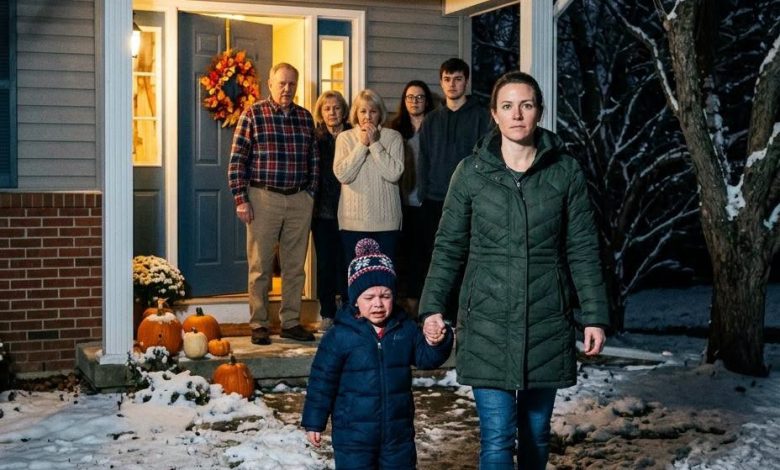
On Thanksgiving night my father took my coat off the hook, opened his front door onto four inches of snow, and told me to take my four-year-old and never come back — so I knelt down, zipped my son’s jacket under his chin, walked him to the car without raising my voice, and made one telephone call that nobody in that house knew I was able to make.
I am Nicole. I am thirty-two.
I do digital marketing consultancy for eleven small businesses, from a laptop, mostly at night after my son is down.
My son is called Leo and he was four years and two months old on the twenty-seventh of November.
The house is on Ferncastle Lane in Westchester County. Four bedrooms, a screened porch my mother is very proud of, and a kitchen island she had put in the year everything went wrong.
There were five of us at that table. My father Richard, sixty-seven. My mother Patricia, sixty-four. My younger sister Natalie, twenty-nine. Her husband Terrence, thirty-four, who is in finance and who has never once asked me a question about myself.
It started with a glass of cranberry juice.
Terrence had been talking since the plates went down about a trip to Cabo, and about a watch, and every time he crossed his legs he found another way to put his suede loafers where the light was.
Leo reached across for his cup. His hand slid on the wet outside of the glass and it went over.
Red juice across the cloth, across the table runner my mother bought in Charleston, across the floor, and across one of those loafers.
Natalie was out of her chair before the glass stopped rolling. “Can you not control him for one single meal?”
Leo went completely still, the way he does.
I was already reaching for the napkins and already saying I am sorry, and I had not got one drop of it up off the wood before my mother said the thing she had evidently been keeping somewhere for four years.
She looked at my son, and then she looked at me, and she said: “He is your mistake. We are tired of paying for him.”
I want to be precise about that sentence, because it is the load-bearing one.
My parents have never paid for anything for Leo. Not a coat, not a cup, not one hour of daycare. They have been barely managing their own costs for years.
I have paid for things for them. I will come back to that.
Natalie was always the one. She married the man with the business cards, she wears the right coat, she is in the photographs they put out at the club. I am the one they call when a website is down, or a bill looks wrong, or somebody needs talking to on the telephone.
At that table, Leo and I were guests who were expected to be visibly grateful, and I had got very good at it.
So when my father pushed his chair back and went to the hooks by the front door and took my coat down, I did not argue. Arguing in that house has never once worked and it has always cost me something.
He pulled the door open. The cold came in across the floor.
“Get out,” he said. “And never come back here.”
I looked at him for a second and I asked him one question, quietly, and I meant it more literally than anybody in that hallway understood.
I said: “Are you certain about that?”
He laughed at me. He actually laughed.
And from behind him my mother said: “Natalie and Terrence need your old room anyway.”
That is the second load-bearing sentence and I will come back to that one too.
I knelt down on the mat and I zipped Leo’s coat up under his chin and I put his mittens on him and I took his hand, and we went out.
The door shut behind us and I heard the deadbolt go over.
It is forty feet from that door to the end of the driveway. I have walked it about nine hundred times in my life and that was the first time I ever counted it.
I got him into the back of the car and I started the engine and I put the heat on full and I sat with the door open and my hand on his knee until he stopped hitching.
He asked me if we were in trouble.
I said no. And then I got my phone out.
Here is the part the four people inside that lit house did not know.
In the spring of 2021 my parents lost that house.
Not dramatically, and not publicly. Richard had put eleven years of a second mortgage and two credit lines into looking like a man who did not need any of it. The bank filed in the February. By the April it was finished.
What they tell people at the club is that an investment company “restructured” it. A buyer appeared, bought the property outright, and leased it back to them at fourteen hundred and fifty dollars a month, which for that house in that county is roughly a third.
They have told that story so many times that I think my father believes a stranger did it out of respect for him.
They never asked enough questions about the company. They never read every page of the lease. And in four years neither of them ever wondered why the owner’s attorney answered the telephone inside ten minutes whenever a boiler went.
The buyer is a limited liability company registered in New York. It has one member. It has had one member since the day it was formed on the ninth of March 2021.
I bought my parents’ house for four hundred and twelve thousand dollars. I used everything I had, I used a hard money bridge at an interest rate I am embarrassed to write down, and I spent two years paying it off at my own kitchen table at eleven at night.
I did it because my mother cried on the telephone in the February of 2021 and said she did not know where they would go.
And then I never told them. Not once in four years.
I told myself that was dignity. I have had some time to think about it since and I am fairly sure it was cowardice, because a person who is told will eventually thank you, and being thanked would have meant being seen, and somewhere along the line I had decided that was not available to me.
So I sat through four Christmases of being asked when I was going to get a real job, in a house I owned.
I sat through my mother telling a room that Natalie had “done things in the right order”, in a house I owned.
And on Thanksgiving I stood on a doormat I owned and let a man hand me my coat.
The lease is eleven pages. It was drafted by David, my real estate attorney, who has handled every piece of this from the beginning and who told me in 2021 that I would regret the silence, and was right.
My parents did not have a lawyer look at it. I know that for a fact, because David offered twice, in writing, and my father said he had been signing contracts since before David was born.
Clause 11(c) is four lines long and it is on page six.
It says that the premises are let to the two named tenants only, that no further person may take up occupancy for more than fourteen consecutive days without the written consent of the owner, and that if that happens the owner may terminate on ten days’ notice.
It is a standard clause. It is in every residential lease David has ever written. It is there to stop somebody quietly moving four more people into a four-bedroom house.
Natalie and Terrence moved into the back bedroom on the eighth of November.
Not for Thanksgiving. Properly. A rented van, on a Saturday, with a bed frame and eleven boxes, because Terrence’s firm had restructured him out in the October and they had given notice on the apartment in White Plains.
Nineteen days before my mother told me my son was a mistake they were tired of paying for, my sister had moved into a house she believed belonged to a stranger, and not one person in that family asked the owner anything at all.
I had known since the ninth of November. I had decided to do nothing about it.
I sat in that car with the heater roaring and my son asleep in four minutes flat, the way small children go under after they have been frightened, and I called David at nineteen minutes past eight on Thanksgiving night.
He picked up on the third ring with a houseful of people behind him.
“Nicole? It’s Thanksgiving.”
I said: “I know. Do you still have the Westchester file?”
He said yes. He did not ask me anything else for about six seconds.
Then he said: “The 11(c) notice is already drafted. It has been sitting in the folder since the tenth.”
I said: “Use it.”
He did not tell me to sleep on it. He has known me for four years and he had been waiting for that telephone call since the ninth of November, and possibly since 2021.
I drove Leo into Manhattan and checked us into a hotel and got him into the bed with his coat still in his fist, because he would not let go of it.
At twenty-two minutes past ten my phone lit up with four words.
We are on the porch.
I opened my laptop on the desk by the window with the lamp off, and I brought up the exterior cameras on the house. The owner installed them in 2022. The owner pays the monitoring. The owner is me.
Patricia was in the kitchen with a glass of wine and the dishwasher going. Richard was in his chair with a cigar and the television on. Upstairs, on the hall camera, Natalie had a tape measure out against the wall of my old bedroom and Terrence was leaning in the doorway laughing at something.
Then the porch camera picked up headlights on the turn. Three sets of them. Doors.
David in a dark wool coat with a manila folder flat against his chest. Two county deputies behind him at the bottom of the steps, snow coming down through the porch light onto their shoulders. The flag by the door going sideways in the wind.
He pressed the bell, and I heard it through the camera about half a second after I heard it somewhere in my own chest.
My father came across the hall and opened his own front door the way he has opened it his whole life, which is as though everything behind it belongs to him.
He started before David said a word. The lease. His rights. Thirty-one years in this village. A man he knows at the county.
David let him run all the way out, which took one minute and fifty seconds, and I know that because I have the footage.
Then he opened the folder to page six, turned it around so that it faced my father, and put one finger flat on the bottom of the page, next to his own signature.
And he said: “The owner has asked me to remind you —”
And my father reached out and took the corner of it.
— of clause eleven, subsection C.”
My father read it twice. You can watch him do it.
Then he said, and this is on the audio: “Who is the owner?”
And David said: “My client has owned this property since April 2021. You are in breach of 11(c). This is your notice to quit.”
My mother had come up behind him by then with the wine glass still in her hand.
She said the thing I expect to hear for the rest of my life, which is: “Is it the bank?”
Twenty-two minutes later Natalie came down the stairs with the tape measure still hooked on her finger and asked what was going on, and nobody in that hallway was able to tell her.
David did not say my name. He is not permitted to and he would not have anyway.
What he did was hand my father the ten-day notice, and a second sealed envelope addressed to him in my handwriting, and then he said good night and walked back down the path, and the deputies went with him.
Eleven minutes on the porch, start to finish.
The letter inside the envelope was four sentences long.
It said that I had bought the house in April 2021. It said what I had paid for it. It said that the rent they had been paying for four years had never once covered the taxes and the insurance, let alone the note. And it said that the notice was not about Natalie’s bed frame.
My father called me at eleven minutes past midnight. I did not answer.
He called nine more times before six in the morning, and then he stopped and my mother started, and by the Saturday it was Natalie, who left a voicemail that I have kept, in which she explains to me that I am being extremely immature.
Here is what actually happened afterwards, and it is not the ending anybody wants.
I did not put my parents out of that house.
I let the ten days run, because I wanted them to sit in it, and I am not going to dress that up as anything other than what it was.
On the eighth of December David served a second document. A new lease, one year, twenty-two hundred a month, which is still well under the market and which is roughly what that house actually costs me to hold.
Two named tenants. Richard and Patricia. Clause 11(c) unchanged and initialled separately this time, on its own line, which was David’s idea and which I enjoyed more than I should have.
Natalie and Terrence had eleven days to find somewhere. They are in a two-bedroom in Yonkers. Terrence started at a smaller firm in the February.
My mother signed the new lease on the twelfth of December in David’s office. I was not there. I have not been in a room with her since the twenty-seventh of November.
She wrote to me in the January. Four pages. It is a good letter in the way letters are when somebody has finally been frightened, and about two-thirds of the way down the third page she says that she did not mean it about Leo, that it was the wine and the ruined table.
I believe that she believes that.
I have not answered it. It is in the drawer of the desk I am writing this at.
Leo turns five in September. He does not remember the driveway. He remembers the hotel, because the bath had jets in it and he had never seen one before.
People keep telling me I should have said something in 2021.
They are right, and they have the reason wrong.
It is not that I should have made them grateful. Gratitude from those two would have turned into something else inside a month and I knew that at the time.
It is that for four years I let my son sit at a table where he was tolerated, in a house his mother owned, because somewhere along the line I had decided that being quietly useful was the most I was ever going to be given.
He is the one who paid for that. And he is the only person in this entire story who did nothing wrong.
The rent still arrives on the first of every month, by transfer, from my father’s account.
It has not been late once.


