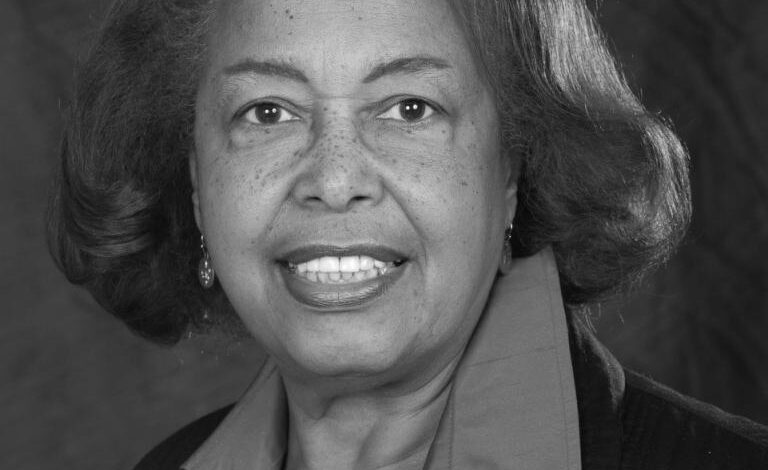
Her mother scrubbed floors so she could go to medical school.Gladys Bath said this plainly, without bitterness — simply as a statement of fact and of love. When Patricia entered middle school, her mother went to work as a domestic, cleaning other people’s houses. In 1950s America, it was one of the few jobs available to Black women, and the money she earned was directed toward her daughter’s education. Patricia Bath carried that memory for the rest of her life.
She spoke about it in interviews and speeches. She understood it as both a weight and fuel — the sacrifice someone she loved had made for her future.Born on November 4, 1942, in Harlem, New York, Patricia was the daughter of Rupert Bath, a Trinidadian immigrant who worked as a motorman on the New York City subway — the first Black man to hold that position — as well as a merchant seaman and newspaper columnist. Her mother, Gladys, was a descendant of enslaved Black people and Cherokee ancestry. Rupert, educated and well-traveled, taught his daughter about astronomy and the diverse cultures of the world. He also taught her what it meant to be the first in spaces that had never welcomed people like them — and that being first was not a reason to stop.From childhood, Patricia was ferociously curious.
She became editor of her high school science paper. At just sixteen, she was selected for a National Science Foundation summer research program at Yeshiva University, where she studied the relationship between nutrition, stress, and cancer. There, she developed a mathematical equation for predicting cancer cell growth that her mentor later presented in a scientific paper. The work was hers.She earned her bachelor’s degree in chemistry from Hunter College in 1964 and her medical degree from Howard University College of Medicine in 1968, graduating with honors. She returned to New York for her internship at Harlem Hospital and her ophthalmology fellowship at Columbia University.
The two institutions stood at opposite ends of the city — and on opposite sides of a painful reality.At Harlem Hospital’s eye clinic, nearly half the patients were blind or visually impaired. At Columbia’s eye institute, which served a predominantly white and more affluent population, the blindness rate was only a fraction of that. Bath observed the stark disparity with the trained eye of a scientist and refused to accept it as inevitable. She understood it was not a biological difference — it was a difference in access.Through a retrospective epidemiological study, she confirmed what she had witnessed: Black Americans were going blind at twice the rate of white Americans, not because of genetics, but because they received far less eye care. The problem was