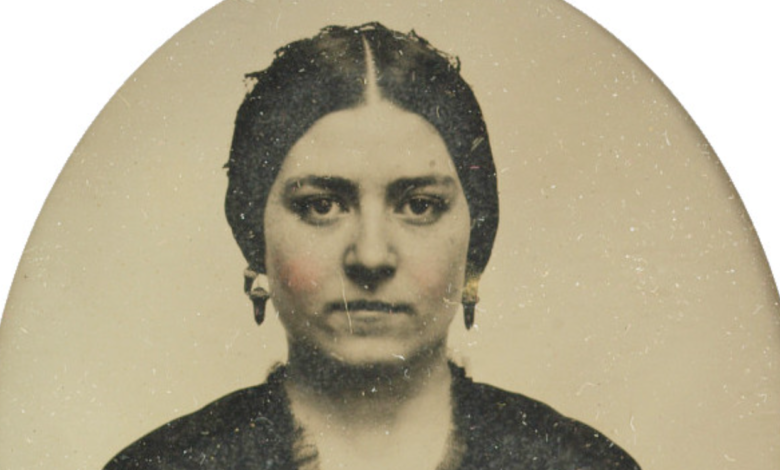
In July 1856, the clipper ship Neptune’s Car set sail from New York Harbor bound for San Francisco. On deck stood the captain’s 19-year-old wife, Mary Ann Brown Patten — four months pregnant — watching the city slowly disappear behind her.Mary had sailed with her husband, Captain Joshua Patten, before. She wasn’t merely a passenger. She had studied navigation alongside him — reading charts, learning celestial navigation, and mastering the complex mathematics of finding a ship’s position by the stars. Joshua recognized her intelligence and treated her as a true partner worth teaching.
She had no idea how desperately she would need those skills.Weeks into the voyage, Joshua collapsed. Violent headaches and fever quickly gave way to total blindness. Doctors later believed it was meningitis. The captain of Neptune’s Car could no longer see the horizon, read a chart, or issue commands.Control should have passed to the first mate, Mr. Hare.But it couldn’t.Evidence had surfaced that Hare had deliberately steered the ship off course — possibly attempting to sabotage the voyage. Even from his sickbed, Joshua knew the man could not be trusted. Hare was placed in the brig. The second mate was loyal and capable, but he lacked the advanced navigation skills required to guide a clipper ship safely around Cape Horn — the most treacherous stretch of ocean on Earth, where storms strike without warning and countless vessels have been lost.Mary faced a clear and daunting choice.A man she could not trust. A man who could not navigate. And a dying husband who had taught her everything he knew.
She took command of Neptune’s Car.The crew resisted at first. Some questioned her openly. Others expressed doubt through silence. Mary did not waver. She studied the charts, calculated their position using the stars, and plotted their course through the infamous storms of Cape Horn with the precision Joshua had taught her.She gave orders with quiet authority and maintained discipline without cruelty. And every night, after battling rough seas and managing a skeptical crew, she went below deck to care for her blind, dying husband.For more than fifty days, she navigated the brutal waters around Cape Horn.She worked to the point of exhaustion, sleeping only in short intervals, always listening for any change in the ship’s movement that signaled danger. She handled crisis after crisis with steady hands and sharp judgment. The crew watched her closely.Slowly, doubt turned into respect.In November 1856, after 136 days at sea, Mary Ann Brown Patten guided Neptune’s Car safely into San Francisco Harbor. Every crew member was alive.
The cargo was intact. The ship was sound.She had successfully navigated one of the most dangerous maritime passages in the world — while pregnant, while caring for her dying husband, and while commanding a crew of men who had never imagined taking orders from a 19-year-old woman.Tragically, Joshua Patten died just months after their arrival. Mary gave birth to their son, a child his father never clearly saw.The shipping company awarded her $1,000 and issued a public statement praising her competence — remarkable words for 1856. Newspapers hailed her as a heroine. Maritime historians still study her navigation logs, noting their remarkable precision.Mary Ann Brown Patten never sought fame.
She simply faced an impossible situation and did what needed to be done.But her story teaches something deeper than the drama of the voyage.Joshua Patten had looked at his young wife and decided she was worth teaching. He shared his professional knowledge with her not because he expected her to need it, but because he respected her mind enough to include her as an equal. That partnership — a husband who treated his wife as an intellectual equal — is what ultimately made everything else possible.She was only 19 years old.She navigated Cape Horn.She brought every soul on that ship home safely.And she did it because someone had believed, long before the crisis arrived, that she was worth teaching.