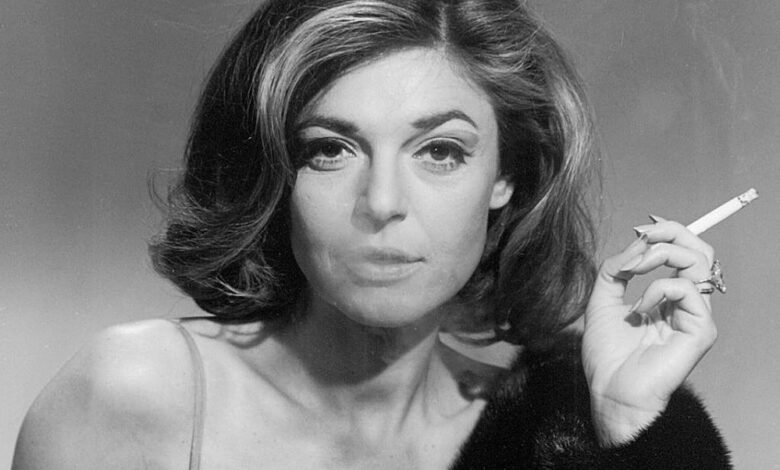
By late 1966, Anne Bancroft had already secured her place in Hollywood.She had won an Academy Award in 1962 for The Miracle Worker, playing Annie Sullivan, the devoted teacher who helped young Helen Keller connect with the world. It was a physically brutal and emotionally exhausting performance. The famous dining room confrontation scene alone took five days to film.She earned a second Oscar nomination for The Pumpkin Eater in 1964.
She was respected, admired, and known for serious, dignified roles both on Broadway and in film.She was safe.Then Mike Nichols called.He was casting a dark comedy called The Graduate. The story followed a directionless recent college graduate who begins an affair with an older woman — the wife of his father’s business partner — and later falls in love with her daughter.The older woman was Mrs. Robinson: bored, drinking too much, and trapped in a loveless marriage.Nichols approached several established Hollywood actresses. Doris Day turned it down. Patricia Neal passed. Ava Gardner wasn’t interested. No one wanted to play Mrs. Robinson. The role was considered too sexual, too unseemly, and too risky for an actress’s image.Anne Bancroft read the script.She said yes.She was thirty-six when filming began, while Mrs. Robinson was meant to be a middle-aged woman whose best years were behind her.
The makeup department added a grey streak to her hair and dressed her entirely in animal prints — leopard and tiger stripes. Nichols wanted her to look like a predator.But there was a problem.Anne was playing the role too warmly. Nichols pulled her aside and told her directly that she was being far too nice. He then did something he rarely did: he gave her a line reading — cold, empty, and bitter.Anne understood immediately.“I can do that,” she said. “That’s anger.”The film paired her with a twenty-nine-year-old Dustin Hoffman in his first major movie role. Anne was only six years older than Hoffman, yet on screen she became the definitive archetype of the older woman, the bored housewife, and the cautionary tale of a life that didn’t turn out as planned.She played the part with ice-cold precision — no warmth, no vulnerability, only calculation and contempt.The Graduate premiered in December 1967 and became a cultural phenomenon. The Simon & Garfunkel soundtrack helped make it one of the first films defined by its music.
The story perfectly captured a generation’s feelings of alienation and drift.Anne Bancroft received her third Oscar nomination for Best Actress.And Mrs. Robinson became one of the most iconic characters in film history.But for Anne Bancroft, the success became a burden.“I gave a voice to the fear we all have,” she said years later. “That we’ll reach a point in our lives, look around, and realize that all the things we said we’d do and become will never come to be — and that we’re ordinary.”She had won an Oscar for one of the most physically demanding performances ever put on film. She had earned critical acclaim on Broadway in multiple Tony Award-winning roles. She would go on to receive two more Oscar nominations, win an Emmy, and achieve the Triple Crown of Acting — Oscar, Tony, and Emmy.Yet whenever people saw Anne Bancroft, they saw Mrs. Robinson.She remained ambivalent about The Graduate for the rest of her life. She understood its cultural importance and knew it was a great role, but it wasn’t the one she wanted to be remembered for.Anne Bancroft died on June 6, 2005, at the age of seventy-three.
Her obituaries led with The Graduate.This is the paradox of her career: She took a role that every other major actress in Hollywood had turned down because it was too risky. She played it brilliantly. It became the most famous performance of her life. And she spent decades wishing it hadn’t.Because when you create a character that iconic and unforgettable, it doesn’t just define you — it consumes you.For those who have done something brilliantly that overshadowed everything else they built before and after, who understand that taking the risky role everyone else rejected and playing it with absolute precision can create both cultural permanence and personal ambivalence, who know that winning every major award across stage, screen, and television and still being remembered primarily for one role at age thirty-six means legacy is not always what the person who built it would have chosen — this story might feel like recognition.Mrs. Robinson gave voice to a fear so universal that it outlasted everything else Anne Bancroft accomplished. Sometimes the most iconic thing you do is the very thing you most wanted the world to see past.