At fifteen, Frances Smith sat alone in a Memphis hospital, cradling her newborn son. Her husband had already left. With no money and no education, her future seemed destined for the same quiet hardship faced by countless girls in similar situations.But she possessed one gift the world could not take away: her voice.She sang wherever she could find a stage—church events, radio stations, and small performances that barely paid the bills. One day a local radio executive heard her sing and gave her a chance. Gradually, a new name emerged:
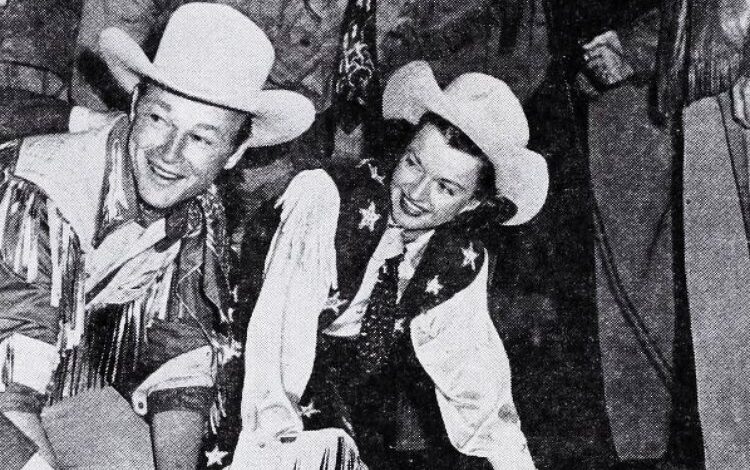
Dale Evans.She initially disliked the name. “Dale is a man’s name,” she protested. But Hollywood wasn’t interested in her objections.By the early 1940s, California studios recognized her potential and signed her to modest film contracts. There was one condition: she had to hide the truth. In public, her son Tommy would have to be presented as her younger brother—a secret she carried for the sake of her career.She accepted the lie because she needed to survive.In 1944, Republic Pictures teamed her with Roy Rogers, the beloved cowboy star.
There was just one issue: Dale didn’t know how to ride a horse. Roy later joked that he had “never seen so much sky between a woman and a horse.” Still, audiences adored them together.For years they made films and became America’s favorite Western couple. Dale continued to guard her secret while performing and building her career. Then, in 1947, she married Roy Rogers—the man who would change her life.When their daughter Robin was born in 1950 with Down syndrome and a serious heart condition, doctors advised the couple to place her in an institution and keep her hidden. Roy and Dale refused.
They brought Robin home, supported her through numerous surgeries, and loved her fully. When Robin passed away just before her second birthday, Dale turned her grief into something meaningful: the book Angel Unaware, which helped change how many Americans viewed children with disabilities—not as something to hide, but as full human beings worthy of love and dignity.More tragedies followed.
Two additional children died in the years afterward.Yet Dale kept singing, writing, and showing up. One night in 1951, just before a radio broadcast, she quickly jotted lyrics on an envelope. That song, “Happy Trails,” became the beloved anthem of her life with Roy—a reminder that not every trail is easy, but we walk them side by side.That was Dale Evans’ true gift. She understood that people sing not because life is easy, but because singing is sometimes the only way to endure. And she showed that the greatest courage is not in hiding who you are—it is in refusing to hide any longer.