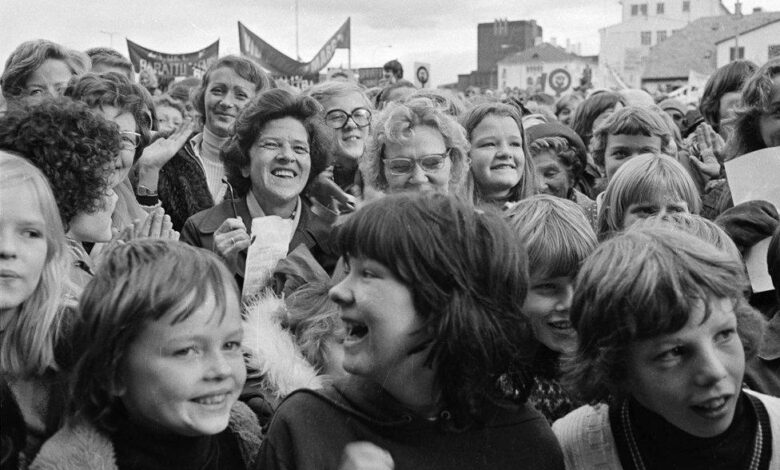
On October 24, 1975, Iceland witnessed one of the most powerful and unified acts of protest in modern history: the historic Women’s Day Off (Kvennafrídagurinn). On that single day, an estimated 90% of Icelandic women—tens of thousands across the entire nation—walked off the job, refusing to perform both their paid employment and their unpaid domestic labor at home.The goal was clear and bold: to spotlight the deep-rooted gender inequalities that persisted in Icelandic society and to vividly demonstrate just how indispensable women were to every aspect of daily life and the national economy. The impact was immediate and impossible to ignore. With the vast majority of women absent, the country essentially ground to a halt in many sectors.
Schools and kindergartens were forced to close or operate on emergency schedules, numerous businesses and offices ran with skeleton crews or shut down entirely for the day, banks and shops struggled, and newspapers printed dramatically reduced editions. Fathers across the nation suddenly found themselves bringing children to work, carrying them on their shoulders into factories, offices, fish-processing plants, and government buildings—scenes that became iconic symbols of the strike’s disruption and its underlying message.The massive participation and the visible chaos that followed sent a resounding shockwave through Icelandic society and politics. It forced a national reckoning with the unequal distribution of labor, pay, and opportunities between men and women.
Politicians, employers, and the public could no longer pretend that women’s contributions were secondary or replaceable.Remarkably, the momentum from that single day of action produced concrete, lasting change in a remarkably short time. Just one year later, in 1976, Iceland passed its groundbreaking first Gender Equality Act. This pioneering legislation established a formal legal framework dedicated to promoting and enforcing equal rights, equal pay, and equal opportunities for women and men in all areas of life—from employment and education to family responsibilities and public participation.The ripple effects continued. In 1980—only five years after the Women’s Day Off—Iceland made global history once again by electing Vigdís Finnbogadóttir as president. She became the world’s first woman to be democratically elected head of state, serving an unprecedented four terms until 1996 and earning widespread admiration for her intelligence, grace, and commitment to equality, culture, and environmental issues.Decades later, the legacy of that 1975 strike remains profoundly evident. Iceland has consistently ranked at the very top of the World Economic Forum’s Global Gender Gap Report for years, often holding the number-one position worldwide in closing the gender gap across economic participation, education, health, and political empowerment.
The country boasts some of the highest rates of female workforce participation, generous parental leave policies shared between mothers and fathers, strong representation of women in parliament and leadership roles, and ongoing efforts to combat remaining disparities.The Women’s Day Off of 1975 stands today as a shining example of what collective action, solidarity, and strategic protest can achieve. It proved that when women withdraw their labor—both visible and invisible—the world must stop and listen, and real, structural change can follow faster than many ever imagined. Iceland’s journey from that transformative day in 1975 to its current status as a global leader in gender equality continues to inspire movements for women’s rights around the world.
Shkruaj te Esat Esat