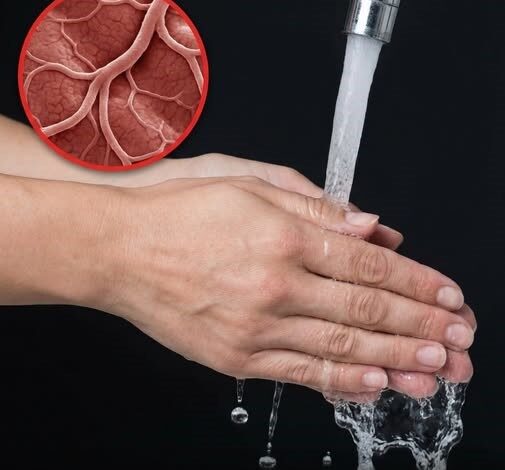
Pruned skin—those familiar wrinkles that appear on your fingertips and toes after prolonged exposure to water—is not, as long believed, a passive consequence of the skin simply soaking up moisture like a sponge. Instead, modern neuroscience and physiology research has revealed it to be a sophisticated, deliberately orchestrated neurological response actively directed by the autonomic nervous system.When your hands or feet are immersed in water for an extended period (typically beyond about 5–10 minutes), specialized sensory nerves in the skin detect the prolonged wetness and trigger a rapid signal to the sympathetic nervous system. This activates a targeted form of vasoconstriction: the tiny blood vessels (arterioles and capillaries) just beneath the surface of the glabrous (hairless) skin on the palms, fingers, toes, and soles dramatically narrow. As blood flow to these areas decreases, the underlying tissue volume shrinks slightly, pulling the outer dermal and epidermal layers inward. The result is the characteristic puckering, ridging, and deep furrows we recognize as “pruney” fingers.
This isn’t merely a mechanical byproduct—it’s an adaptive mechanism with a clear evolutionary advantage. Studies, including controlled experiments comparing grip strength in wet versus dry conditions, have demonstrated that the wrinkled texture dramatically improves handling of slippery objects. The ridges act analogously to the tread patterns on tires or the grooves on hiking shoe soles: they efficiently channel water away from the point of contact, displace excess moisture, reduce hydroplaning effects, and create multiple small channels that enhance friction and tactile feedback. In practical tests, people with naturally pruned fingers consistently outperform those whose fingers remain smooth (for example, individuals with certain nerve damage that prevents vasoconstriction) when attempting to pick up wet marbles, submerged tools, or other slick items underwater.Researchers have further confirmed the active neural control by observing that this wrinkling response is absent or severely impaired in people with conditions affecting sympathetic nerve function—such as certain neuropathies, spinal cord injuries, or after local nerve blocks—proving it depends on intact nervous system signaling rather than osmosis or simple water diffusion alone.
The phenomenon is also remarkably specific: it occurs predominantly on the glabrous skin of the hands and feet (areas already specialized for fine touch and grip), spares most of the rest of the body, and reverses quickly once the skin dries, with blood vessels reopening and tissue volume restoring within minutes to hours.Far from a quirky, useless quirk of prolonged bathing, finger and toe pruning represents a finely tuned evolutionary adaptation that enhances manual dexterity and object manipulation precisely when the environment is wet and traction is most challenging. It showcases the body’s ingenious ability to dynamically remodel its surface structure—on demand and under neural command—to optimize performance and survival in changing conditions, turning what once seemed like a minor annoyance into a brilliant example of biological engineering at work.