From Studio 54 at Age 9 to Emancipation at 14: How Drew Barrymore Rebuilt Her Life From Scratch

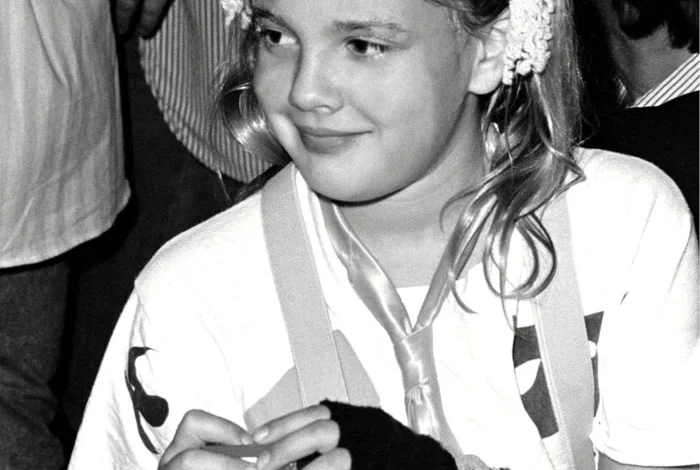
In 1982, seven-year-old Drew Barrymore became one of the most famous child stars in America. Steven Spielberg’s E.T. the Extra-Terrestrial was the highest-grossing film of the decade, and Drew’s performance as Gertie was so natural and endearing that she won a Young Artist Award and became the youngest person ever to host Saturday Night Live. To the world, she appeared to be a cherubic child star with a bright future and a legendary acting family behind her — her grandfather John Barrymore was widely regarded as one of the greatest Shakespearean actors of his time.
However, behind the scenes, Drew’s childhood was already falling apart. Her father left when she was an infant and remained mostly absent from her life. Her mother, Jaid, became her manager and began treating her more like a peer than a child. When Drew was around eight or nine years old, Jaid started taking her to Studio 54, the famous Manhattan nightclub known for its wild adult atmosphere. What began as visits soon became a regular part of her childhood. By the age of twelve, Drew had developed a substance dependency.
She entered treatment for the first time at twelve, but it did not last. At thirteen, her mother had her committed to an adult psychiatric facility in California. Drew felt blindsided and betrayed, yet she also recognized that she needed help. She spent eighteen months in the facility, later describing it as a very difficult, dark, and extremely long period — but exactly what she needed. Shortly after being released at fourteen, Drew faced another severe crisis and returned to treatment. During this time, clinicians told her she would be better off living independently. They recommended legal emancipation. At just fourteen years old, Drew Barrymore stood in juvenile court and asked a judge to declare her legally independent from her parents. Her mother, acknowledging her own failures, supported the decision.
The judge looked at her and warned, “I can turn the clock forward, but I can never turn it back. Are you ready for that?” Drew said yes. She moved into her own apartment and began paying her own rent. Considered trouble in Hollywood, she was largely blacklisted from acting roles. She worked in coffee shops and restaurants while going to auditions, most of which resulted in rejection. At fifteen, she published her memoir Little Girl Lost, which was brutally honest and became a New York Times bestseller. Slowly, her career began to recover. Small roles eventually led to bigger opportunities. In her twenties, she starred in hits like
The Wedding Singer, Never Been Kissed, and Charlie’s Angels. She founded her own production company, Flower Films, and took greater creative control of her work, becoming one of Hollywood’s most successful actress-producers. She later became a mother to two daughters, Olive and Frankie. Motherhood gave her the chance to create the kind of stable, slow childhood she never had. She has spoken about wanting rules, boundaries, and protection for her girls. Drew eventually rebuilt a relationship with her mother and continues to support her financially. “I can’t turn my back on the person who gave me my life,” she has said. That kind of grace comes from years of therapy and the hard-earned realization that healing is not about erasing the past, but about integrating it. Studio 54 at nine. First treatment at twelve. Psychiatric facility at thirteen. Emancipation at fourteen. And then a life built from scratch, on her own terms. When a judge told her at fourteen that he could only turn the clock forward, Drew accepted it — and never looked back.