The Girl Who Walked Out of Hell: Mary Vincent’s Extraordinary Story of Survival and Strength

A teenage girl disappeared into the California night. Hours later, she emerged from a desert ravine and began walking toward history.September 29, 1978. Fifteen-year-old Mary Vincent stood along a road in Berkeley, California, hoping to reach Los Angeles to visit her grandfather. Like many teenagers seeking independence, she thought she was simply starting an adventure.She could not have known that before sunrise, she would be fighting for her life.Mary had already endured more hardship than many people twice her age.
Raised in a difficult home, she had learned resilience early. Friends described her as energetic, creative, and determined. At just thirteen, she had even performed a solo dance routine at the Miss Universe pageant in Las Vegas.But nothing could have prepared her for what awaited.As evening fell, a van pulled over and offered her a ride south. What started as a simple hitchhike soon turned into a nightmare.By the next morning, Mary found herself alone in a remote desert area, severely injured and left with almost no chance of survival.Most people would have given up. Mary Vincent did not.Drawing on a survival lesson from her childhood, she focused on one single goal: stay alive.Then she did something that still amazes people decades later. She climbed out of the ravine. She reached the road. And she walked.Records show that Mary traveled nearly four miles before she was finally spotted by passing motorists, who rushed her to safety.
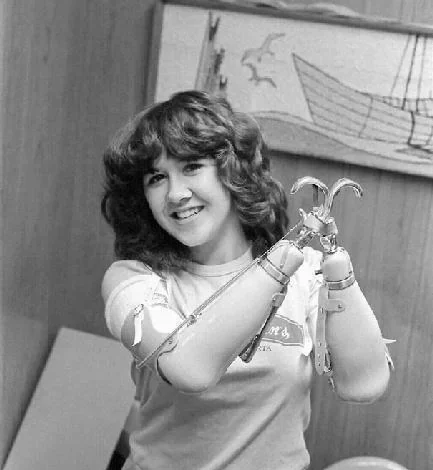
She was only fifteen years old.Doctors fought to save her life. Investigators were stunned by the clear, detailed description she gave of her attacker, which led to his identification and arrest within days.Then came another extraordinary moment. Just months later, still adjusting to her newly fitted prosthetic arms, Mary walked into a courtroom and faced the man who had tried to destroy her. She testified with remarkable courage and strength.The conviction that followed brought national attention, but Mary’s greatest battle was never in the courtroom. It was rebuilding her life.The years that followed were incredibly difficult. She faced emotional trauma, financial struggles, and the daily challenge of adapting to a changed world.Yet something beautiful emerged from the darkness. She discovered a powerful gift she never knew she had: art.Using her prosthetic arms, Mary began creating vibrant paintings and sculptures.
Through art, she found healing, self-expression, and a renewed sense of purpose.What could have been the end of her story became the beginning of a new chapter.Years later, fate brought her back to a courtroom once more. When her attacker faced trial for another violent crime, Mary chose to testify again — not for revenge, but for justice. Her testimony helped ensure he would never harm anyone else.Her case also played a key role in inspiring important changes in California sentencing laws. The legislation, often called the “Singleton Bill,” increased penalties for violent crimes, leading to longer prison sentences for serious offenders.But laws are not her greatest legacy.Mary Vincent went on to become an artist, advocate, public speaker, and founder of a nonprofit organization dedicated to supporting survivors of violent crime.
She turned her unimaginable tragedy into a mission to help others.Many people know what happened to her in 1978. Far fewer know the full story of what came after.She chose to create. She chose to serve. She chose to keep moving forward.The teenager who once walked alone through the darkness became a guiding light for countless others facing their own impossible journeys.Some people survive a terrible chapter. Mary Vincent turned hers into an entirely new book.And sometimes the strongest hands are not the ones we are born with — but the courage we carry inside us.