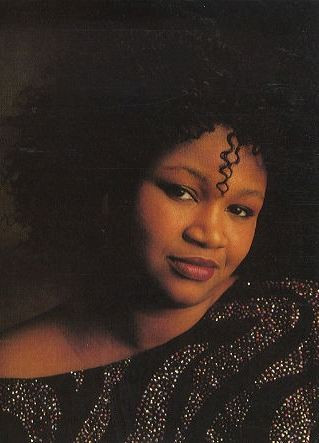
Her father started teaching her piano when she was eight years old in Newark, New Jersey. On Sundays, her powerful voice filled the rafters of her church choir.By high school, she was singing in a group called the Ebonettes. In her early twenties, she taught elementary school by day and pursued music by night — that special kind of exhaustion that demands everything from the person but never takes away from the music.Her name was Gwen Guthrie, and by her own cheerful account, her recording career began at the very top.In 1974, a backup singer scheduled for an Aretha Franklin session fell ill. They needed a voice that could walk in cold and deliver flawlessly. Guthrie stepped in beside Cissy Houston on the single “I’m in Love.” For the rest of her life, she loved saying that her career on record started at the top
. She wasn’t being immodest — she was simply telling the truth.After that, the doors flew open, and she walked through every one.She sang jingles, sometimes alongside her friend Valerie Simpson of Ashford & Simpson. She formed a songwriting partnership with trombonist and bassist Patrick Grant. Together, they wrote Ben E. King’s comeback hit “Supernatural Thing” and seven tracks on Sister Sledge’s 1975 album Circle of Love. People in the industry began calling them the next Ashford & Simpson.Her name appeared in the credits. Other people’s names appeared on the marquee.That was the shape of her career for years — the voice you heard and the pen you felt, without ever knowing it was hers.In 1978, she traveled to Jamaica and the music cracked wide open. She worked with the island’s best musicians and spent years singing with Peter Tosh, alongside the legendary rhythm section of Sly Dunbar and Robbie Shakespeare.
Chris Blackwell of Island Records discovered her, and in 1982 she finally stepped out under her own name.The dance floors claimed her first.Her 1983 track “Padlock,” remixed by DJ Larry Levan, became a massive anthem at the Paradise Garage — the legendary New York club that essentially defined a generation’s dance floor experience. She was crowned the First Lady of the Paradise Garage. When Gwen Guthrie took the stage, the room was hers.Then came 1986, and the record that would lift her high and knock her down at the same time.She wrote and produced “Ain’t Nothin’ Goin’ On But the Rent” herself — a rare feat for a Black woman in 1986. The song opens straight into real life: bills at the door, money tight, and love that doesn’t pay the rent. She took a phrase her grandfather used to say during hard times and turned it into an irresistible groove. She told men they’d better have a job before coming around.
The song shot to number one on the R&B chart and reached number five in the UK.And then some of the same people dancing to it called her greedy.A gold digger. Materialistic. As if a woman simply asking a man to carry his own weight was outrageous.She explained it plainly: the line came from her grandfather, and the two biggest arguments in any relationship are usually money and children. It wasn’t greed — it was a grown woman passing down wisdom from the family table.She wasn’t telling women to chase wealth. She was telling them not to let anyone use them for free. It was one of the oldest survival lessons carried by Black women in America — wrapped in a beat so good that crowds shouted it back for years without fully hearing its truth.Two years later, she proved how badly the critics had misunderstood her.In 1988, at the height of the AIDS crisis — when most artists avoided even saying the word — she released “Can’t Love You Tonight,” a song that confronted AIDS directly. All proceeds went to the People With AIDS Coalition in New York.She stood with dying gay men in silence long before it was safe or fashionable to do so.
On the record sleeve, she wrote her own message: that they were all living under the constant threat and fear of AIDS, and that art could speak truth, enlighten people, and hopefully save lives.The woman they had labeled greedy was quietly trying to keep strangers alive.She continued making music through the 1990s, staying true to herself. Then in 1998, she was diagnosed with uterine cancer. She died on February 3, 1999, in Orange, New Jersey, at the age of forty-eight.Her passing barely registered in the mainstream press.
The radio stations that had played her hits for years didn’t pause. The woman whose voice and songwriting had helped build legends for others slipped away without the recognition she deserved.But her grandfather’s line refused to die with her.It lives on — in clubs, in samples, and on the lips of people who may never know her name. It traveled through Foxy Brown, TLC, and every song since that tells a man to come correct or stay home. Every time someone shouts that hook, they are echoing a truth that began at a family table in Newark, carried forward by a woman who taught school by day, sang backup for legends, wrote hits for others for a decade, then stepped into her own spotlight and created something the world is still dancing to.She did all of that.And then she gave her proceeds to people dying in a crisis that most of her industry preferred to ignore.