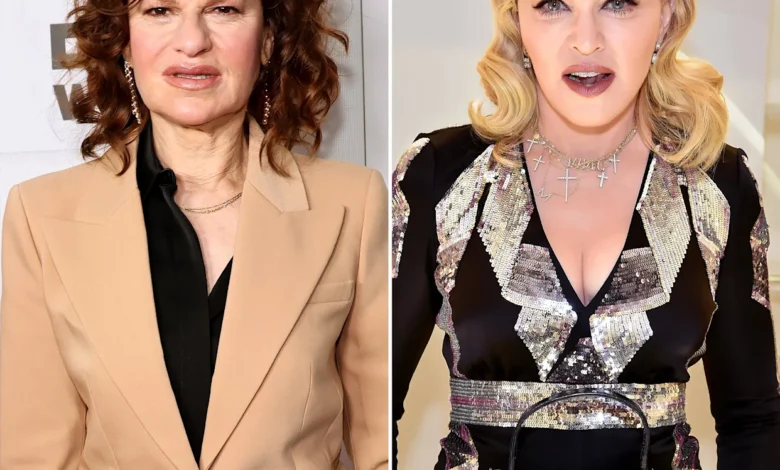
Sandra Bernhard walked onto a stage in New York and began talking about Madonna.She wasn’t praising her. She wasn’t promoting her. She spoke about her in a way that left the audience unsure whether they were watching comedy, gossip, a confession, or something far more intimate.The room fell silent. Then the buzz started. Newspapers picked it up. Television picked it up.
Hollywood couldn’t stop talking about it.And with that, Sandra Bernhard did what she would become famous for doing better than almost anyone else: she made people deeply uncomfortable — and then forced them to pay attention.The real reason her story matters isn’t simply that she became famous. It’s because she built an entire career by saying the things most celebrities were too afraid to say. And sometimes, it nearly cost her everything.Born in Michigan in 1955 and raised in Arizona, Bernhard came to Hollywood without any clear path to stardom. She wasn’t the type of actress studios wanted to turn into America’s sweetheart. She didn’t fit the mold.
That became her greatest strength.While other performers carefully guarded their images, Bernhard created a style rooted in confrontation. Her work blended celebrity culture, politics, sexuality, race, fame, and raw personal confession into something entirely new.People laughed. People got angry. People argued. But above all, they remembered her.Her major breakthrough came in 1982 when Martin Scorsese cast her alongside Robert De Niro in The King of Comedy. The film explored obsession, celebrity worship, and the dark side of fame. Though not a big commercial hit at the time, it later became recognized as one of Scorsese’s most powerful works.Bernhard’s performance was a revelation. Hollywood suddenly understood she wasn’t just a comedian — she could really act.But success didn’t make things simpler.
Sandra Bernhard had no interest in playing it safe or becoming predictable.Throughout the 1980s and early 1990s, she remained one of the most talked-about figures in entertainment. Her stage shows, interviews, and public appearances constantly made headlines.Then came Madonna.Their relationship — whether friendship, feud, rumor, or something in between — became one of the most discussed celebrity stories of the era. The public fascination came from the constant ambiguity. Bernhard blurred the lines between truth and performance so skillfully that no one could tell where the joke ended and reality began.That uncertainty drove the media wild.Was she serious? Was she joking? Was she deliberately provoking?Often, the answer was all three at once.The spotlight grew intense, and so did the backlash. Bernhard built her career in an era when openly discussing sexuality, identity, and celebrity culture could destroy reputations.
Comments that might barely register today could spark national outrage.She walked straight into those controversies time after time.Yet while the arguments raged around her, Bernhard achieved something many controversial figures never do: real longevity.Decades went by. Trends changed. Comedy evolved. Television transformed. But she stayed relevant.In an industry where most people burn bright for a few years and then disappear, Sandra Bernhard endured across multiple generations — not because everyone loved her, but often because they couldn’t ignore her.She understood a truth many celebrities never grasp: being criticized is almost always better than being forgotten.Every performance, every interview, every bold comment carried risk. She accepted that risk willingly.That’s what makes her story compelling. Not because she was always right or universally liked, but because in an industry that rewards playing it safe, she chose to be impossible to ignore.And decades later, that’s exactly what people still re