“The Annie Lennox Story: From Poor Scottish Girl to Defiant Pop Legend Who Changed the Game”

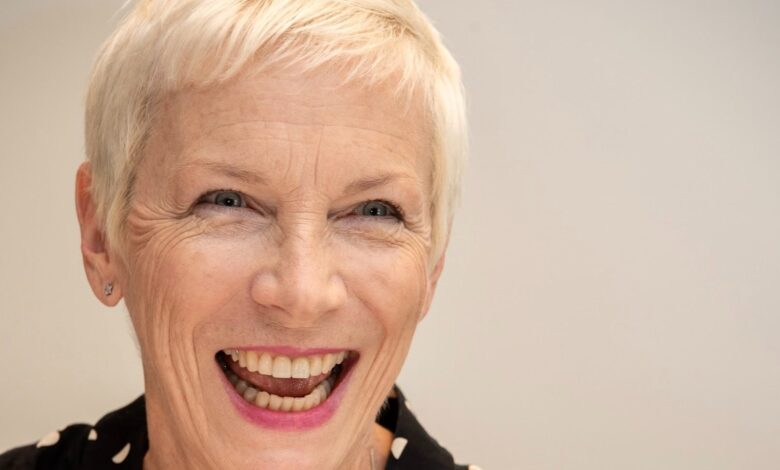
Annie Lennox was born on Christmas Day, 1954, in Aberdeen, Scotland. Her father welded ships and her mother cooked for other families. It was a hard-working, industrial city — not the kind of place typically associated with the extraordinary life she would later build. That contrast is one of the most important things to know about her.She displayed clear musical talent from early childhood, singing and playing piano in a way that stood out in her tight-knit community. At seventeen, she was accepted to the Royal Academy of Music in London to study flute, piano, and harpsichord. She had imagined London as glamorous and full of exciting possibilities.
The reality was much tougher — financial struggles, loneliness, and a deep sense of not belonging. She later admitted she wanted to run back home on her very first day.But she stayed. And she pivoted.Classical music, with its strict forms and formal pathways, wasn’t what she was truly seeking. Rock and roll was. She moved toward it with the clarity of someone who finally recognized the right path after spending enough time on the wrong one.In the late 1970s, she formed a band called The Tourists with guitarist Dave Stewart. They enjoyed moderate success before the group disbanded in 1980 during a tour in Australia. Her romantic relationship with Stewart ended at the same time, but their creative partnership endured.In a hotel room in Australia, while experimenting with a synthesizer, they created a new project.
They named it Eurythmics, inspired by a system of musical education involving movement that Annie had studied. The name reflected her belief in the deep connection between body, sound, physical expression, and music.Their first album, released in 1981, was experimental and sold poorly. Annie felt discouraged, as anyone does when they’ve given everything to a dream and the world has not yet validated it. Still, she kept working. That frustration poured into the songs.In 1983, Sweet Dreams (Are Made of This) arrived.The title track featured an instantly addictive synthesizer riff and Annie Lennox’s powerful, versatile voice — capable of moving from a smoky, intimate low register to soaring strength. Beneath the surface, there was an underlying tension that Dave Stewart later described as their creative philosophy: something that sounds beautiful on top, with something darker and more ominous underneath.The song hit number one in the United States and number two in the United Kingdom. Yet the music video was just as impactful as the song itself.Annie appeared with short, striking orange hair, wearing a sharp men’s suit and holding a cane, staring straight into the camera with an expression that sought no approval.
At a time when female artists were expected to look soft, feminine, and sexually available, her bold androgynous image shattered every convention. It wasn’t a gimmick — it was an authentic expression of her views on identity, gender, and performance. She mixed men’s suits with lace, cropped her hair, and constantly transformed her look, not out of confusion but from a deep conviction that change and fluidity were powerful statements in themselves.At the 1984 Grammy Awards, she performed “Sweet Dreams” dressed as Elvis Presley, complete with sideburns. It was not a joke — it was a provocative statement about gender and performance that sparked intense discussion in the music world.Throughout the 1980s, Eurythmics delivered one hit after another — “Love Is a Stranger,” “Here Comes the Rain Again,” “Would I Lie to You,” “There Must Be an Angel,” “Missionary Man” — releasing nine albums and selling over seventy-five million records. Annie’s distinctive voice became one of the defining sounds of the decade.By 1990, after a decade of relentless touring and recording, she needed a break. While her creative partnership with Stewart continued, the intense cycle stopped.
She had no desire to repeat the past.Her solo chapter began strongly in 1992 when she performed “Under Pressure” with David Bowie at the Freddie Mercury tribute concert. That same year, her debut solo album Diva topped the UK charts, sold millions worldwide, and delivered major hits including “Why” and “Walking on Broken Glass.”In the years that followed, much of her focus shifted beyond music. Having lost friends to AIDS, she became deeply involved in the fight against the disease, especially its impact on women and children in Africa.
She founded the SING campaign in 2007 and The Circle in 2008, a nonprofit dedicated to women’s empowerment and gender equality. She worked with Nelson Mandela’s 46664 charity, addressed the United Nations, and met with world leaders. She consistently used her fame as a tool for causes greater than herself.In 2011, Queen Elizabeth II appointed her an Officer of the Order of the British Empire for her humanitarian efforts. She has served as a UNESCO Goodwill Ambassador and became the first female chancellor of Glasgow Caledonian University.In February 2024, at age sixty-nine, she performed at the Grammy Awards, singing Sinéad O’Connor’s “Nothing Compares 2 U” and ending with a call for ceasefire and peace in the world — a statement that generated both strong support and controversy.She turned seventy on Christmas Day 2024, with more than eighty million records sold, eight BRIT Awards, four Grammys, an Academy Award, and a Golden Globe to her name.
Yet for decades, she has channeled the power of her success into work she considers far more meaningful than additional fame.The iconic orange hair and men’s suit from the 1983 “Sweet Dreams” video were never just a striking image. They were the opening declaration of a philosophy she has lived by for more than four decades: you don’t need to conform to the world’s expectations to be powerful, that strength and vulnerability, fierceness and gentleness, can all exist together, and that fame is a resource meant to serve something bigger than itself.She has been making that argument for fifty years. And she is still making it.