“She Was a Broke Mother of Five – Then Phyllis Diller Took the Stage and Changed Comedy History”

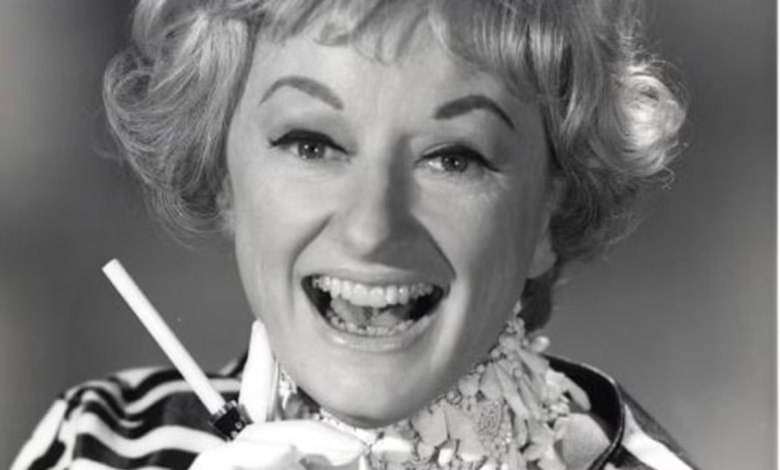
On a March night in 1955, a thirty-seven-year-old mother of five named Phyllis Diller stepped onto the small stage of a North Beach nightclub in San Francisco called the Purple Onion. She wore a strange dress, her hair was teased into a wild shape that defied nature, and she held a long cigarette holder. Then she opened her mouth and began telling jokes about hating cooking, hating cleaning, being broke, being exhausted, and being married to a man she called “Fang” for the purposes of her act. At first, the audience didn’t know what to make of her.
Then they started laughing.Phyllis Ada Driver was born on July 17, 1917, in Lima, Ohio. She attended Bluffton College in the late 1930s, married Sherwood Diller shortly after, and spent the next fifteen years living the typical suburban life expected of a college-educated woman at the time. She had five children. The family moved between several towns. Sherwood was chronically underemployed, and Phyllis worked various jobs throughout the marriage to keep the family afloat.By the early 1950s, after settling in the San Francisco Bay Area, she was working jobs that placed her in front of microphones and typewriters.
She wrote advertising copy, penned a column for a local newspaper, and worked as a publicist for a radio station. At work, at PTA meetings, and at home, she had begun performing a comic monologue — the frustrated rants of a middle-class housewife whose family, in her telling, was slowly driving her mad.Sherwood listened to her routines.While the conventional story portrays Sherwood as the main inspiration for much of her comedy material, he was also the one who encouraged her to take it to the stage. After years of hearing her perform in their kitchen, he told her she should be doing it for money. He pushed her, helped her build an act, and convinced her — despite her strong objections — to walk into the Purple Onion and ask for a booking.She got the gig: two weeks in March 1955. It eventually stretched to eighty-seven weeks.
The act that developed during those eighty-seven weeks was something American comedy had rarely seen before. At the time, women in nightclubs were expected to be singers, dancers, or charming sidekicks. Female comedians, if they existed at all, were supposed to be attractive and tell pleasant jokes. Phyllis Diller broke every rule.She appeared onstage looking like a frazzled housewife who had given up on sleep. Her clothes were loud, her hair was a wild mess, and she wielded her cigarette holder like a weapon. In a voice that sounded like a mix between a chainsaw and an excited bird, she complained about her life — her appearance, her intelligence, her useless husband “Fang,” cooking, cleaning, motherhood, marriage, money, and aging. She even laughed at her own jokes with a loud, cascading cackle that would later become one of the most recognizable sounds in American entertainment.Beneath the chaos was careful precision. What looked spontaneous was meticulously crafted. Diller spent years perfecting her timing, pacing, and delivery.
A young Joan Rivers, who later wrote material for her, called Diller one of the most disciplined comedians she had ever seen. Her self-deprecating style was strategic: by humiliating herself first, she left the audience with nothing left to attack.The strategy worked. By the late 1950s, she was on national television. By the early 1960s, she was a regular on Bob Hope specials, performed on USO tours, and sold out theaters in Las Vegas. She became one of the most recognizable comedy stars in America.Yet her real life looked very different from the character she played onstage. Her first marriage ended in divorce in 1965. She remarried and divorced again. One of her sons suffered from schizophrenia. She underwent many cosmetic surgeries, which she openly joked about, but which also stemmed from deep personal insecurities.
Those who knew her privately described her as quiet, intelligent, well-read, artistic (she was a serious painter), and much gentler than her stage persona suggested. The act was an act. The pain it came from was real.In her 2005 autobiography, Like a Lampshade in a Whorehouse, she explained that comedy had become her form of therapy. She had been given plenty of material by life, and she used it.Phyllis Diller retired from stand-up in 2002 at age 85. She passed away on August 20, 2012, in Los Angeles, at the age of 95.The wild-haired, cackling housewife character she created in that small North Beach club in 1955 opened a door in American comedy that had never been opened before — and no one has been able to close since.And she was laughing the whole time.