We Paid My Husband’s Uncle $9,000 to Harvest Our Peanuts Before the Storm — He Cashed the Check and Drove His Combine to His Own Field, So My Family Brought in 180 Acres With Daddy’s Old 1985 Picker

We paid my husband’s uncle $9,000 to pick our peanuts before a tropical storm hit. Three days later, he cashed our check and drove his combine straight past our field to his own.
That’s how my husband, our two boys, and I ended up bringing in 180 acres ourselves, with my late daddy’s old two-row peanut picker.
Friday, Ten O’Clock
Our peanuts had been dug and turned upside down in neat rows for four days. The pods lay drying in the sun over the red sandy dirt. They were ready.
Uncle Lamar had promised to show up Friday at ten, once the dew burned off. At ten o’clock, we heard his combine.
Only it wasn’t in our field. It was running across the road. On Lamar’s own land.
My husband, Hoyt, drove over and walked right up to the machine. His uncle didn’t even shut off the engine.
“Son, this is the last crop I’ll ever grow. I’ve got to get mine in first.”
“Uncle Lamar, you already deposited our nine thousand dollars.”
“I’ll get to yours when I’ve got time.”
The Storm
The forecast showed a tropical storm coming in Monday night. When heavy rain hits peanuts that are already dug, the pods break off, and what’s left can rot right there in the dirt.
We had 180 acres of vines lying out in the open. Nearly $200,000 in peanuts. And sixty of those acres belonged to Hoyt’s mother, Inez. She’s eighty-one. Her share of the crop is what she lives on.
People asked later why we didn’t sue Lamar. But Hoyt couldn’t take his late father’s brother to court. And no judge on earth could get our peanuts in before Monday night.
Daddy’s Shed
So I walked out to my daddy’s old equipment shed.
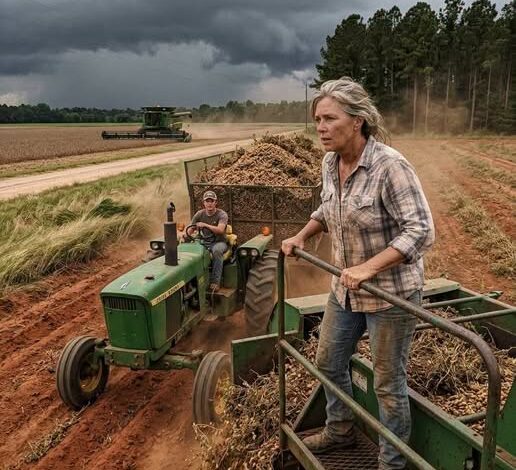
Under a dusty tarp sat his 1985 two-row peanut picker. Nobody had touched it since we parked it there after his funeral. Six years.
Our twenty-two-year-old, Beau, pulled the tarp off and started coughing in the cloud of dust. “Mama, this thing is older than me and Clayton put together.”
“Then I’d say it’s had a long enough vacation.”
The boys went over every inch of it and greased every fitting. Hoyt put on two new belts and swapped out the worn picking fingers.
Digging through the toolbox, I found Daddy’s old grease gun. He’d scratched his initials into the barrel with a nail.
I froze and held it tight. For a second, I could see him crouched by that wheel at six in the morning, getting ready for another long day.
Our eighteen-year-old, Clayton, gently took it out of my hands. “Let me do this part, Mama.”
Four Days
By three that afternoon, we were picking.
Clayton drove the tractor. I rode on the platform of that old green picker, holding the rail with one hand. Hoyt and Beau hauled the full trailers twelve miles to the buying station and back.
Every day, we worked from the minute the morning dew dried until the evening dew came back. Inez, with her bad hip and her cane, insisted on cooking every meal and bringing it to the field.
Saturday was clear and blazing hot. By Sunday, heavy gray clouds were stacking up beyond the pines. On Monday afternoon, the wind turned.
We finished the very last row just as the first sheet of rain came sweeping across the field.
Clayton shut off the tractor and laid his head on the steering wheel. We’d brought in every single acre.
The Buying Station
Tuesday morning, I drove the last trailer to the buying station myself. Trucks were lined up behind me. It looked like half the county had come to unload.
Ardith Coker has weighed and graded our crop for twenty years. She was reading over my grade sheet when the door swung open.
Lamar walked in, clutching his hat with both hands. He looked at the farmers lined up along the wall. Then his eyes landed on me.
Ardith set my grade sheet down on the counter, looked around the crowded room, and spoke loud enough for every single person to hear.
What Ardith Said
“Folks,” Ardith said, “I want y’all to hear this.”
She tapped my sheet. “This family’s crop just graded seventy-six percent sound mature kernels. Best grade I’ve written in this county all season. Hundred and eighty acres, picked in four days, with Walt Tillman’s 1985 two-row picker. A grandmother on a cane cooking in the field. And the last row came in with the rain on its back.”
Then she turned and looked straight at Lamar.
“And I hear they paid somebody nine thousand dollars to do it for them.”
Nobody said a word. In a farming county, everybody knows everybody’s business by Tuesday. Every man along that wall knew whose combine had been running across the road on Friday.
Lamar’s face went red, then gray. Somebody near the door started clapping. Then someone else. Then the whole room. Not for Lamar. For my boys, for Hoyt, for Inez, and for Daddy’s old green picker.
Lamar’s Peanuts
It came out later that Lamar’s combine had thrown a chain Saturday afternoon. He’d lost two days waiting on a part from Albany. The storm caught about a third of his crop still on the ground.
He’d broken his word to his own family to save his peanuts. And he’d lost a good share of them anyway.
The Parking Lot
Lamar followed me outside. He stood by my trailer for a long time, turning his hat around in his hands.
Then he pulled an envelope out of his shirt pocket. A cashier’s check. Nine thousand dollars.
“I went to the bank before I came here,” he said. “I was going to give it to Hoyt. I couldn’t face him.”
“Why, Lamar?” I asked. “Why would you do that to us? To Inez?”
He was quiet. Then he told me something he hadn’t told anyone.
In August, the doctor in Tifton had told him he had Parkinson’s. His hands had already started shaking. He knew this was his last season on a combine. He owed the bank on his land, and he’d figured if he could get every peanut in and sold, he could pay it off and not leave his wife with a mortgage.
“I got scared,” he said. “I told myself y’all would be fine. Y’all always are. That’s no excuse. I know it.”
I looked at his hands. They were trembling on the brim of his hat. I’d thought it was shame. Some of it was.
Supper
I took the check. It was our money, and Inez needed it. But I also told Lamar to come to supper Sunday.
Hoyt didn’t speak to him for the first half of the meal. Inez did all the talking, the way only an eighty-one-year-old woman can. Then she set a plate of peach cobbler down in front of her late husband’s brother and said, “Lamar, you could have asked us for help. That’s what family’s for. Not this.”
Lamar cried at our kitchen table. I’d never seen him cry. Not even at his own brother’s funeral.
Next Spring
Before he left, Lamar made Hoyt an offer. He couldn’t farm anymore. He didn’t want to sell his land to strangers. So he leased all of it to us, at a fair price, on one condition: Beau and Clayton would run his combine.
“Those boys brought in 180 acres with a picker older than they are,” he said. “I reckon they can handle a real machine.”
This spring, my sons planted Lamar’s fields alongside ours. Lamar sits on his porch across the road most mornings and watches them, his hands shaking on his coffee cup, calling out advice nobody asked for.
Daddy’s old two-row picker is back in the shed, under a clean tarp this time.
And his grease gun, with W.T. scratched into the barrel, rides in Clayton’s truck now. He says it’s for luck. I think it’s so his granddaddy can see the harvest.
This story is a work of fiction. Names, characters, and events are products of the author’s imagination. Any resemblance to real people or events is purely coincidental.