The Fastest Woman in the World: Florence Griffith Joyner’s Glory and the Shadow of Doubt

Florence Griffith Joyner stood behind the starting blocks, staring down the track while officials argued quietly a few feet away about whether her time was even humanly possible. One of them kept shaking his head. Another checked the wind gauge again. For a moment, the roar of the Indianapolis stadium sounded strangely distant. Nobody could fully comprehend what they had just witnessed. Athletes leaned forward from the sidelines, squinting at the scoreboard. Reporters sprinted toward telephones before the official results were even confirmed.10.49 seconds.
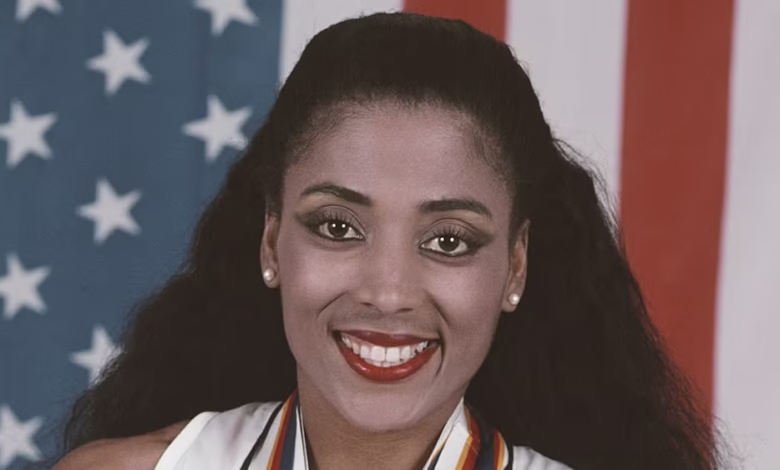
Suddenly, the fastest woman in the world had also become the most doubted.By 1988, Florence Griffith Joyner already looked unlike anyone athletics had ever seen. Six-inch nails painted in bold, vibrant colors. One-legged racing suits. Gold jewelry flashing under the stadium lights as she exploded down the track with a breathtaking combination of elegance and raw power.People stared at her before races even started. Some admired her instantly. Others hated her instantly.Because Flo-Jo didn’t just run differently — she looked different.
And in elite sports, especially in the late 1980s, women who combined glamour with physical dominance often triggered automatic suspicion.The race in Indianapolis changed everything permanently.When Florence ran the 100-meter quarterfinal at the U.S. Olympic Trials in July 1988, the clock delivered a number the sport had never seen from a woman: 10.49 seconds.Even today, decades later, that time still stands as the women’s world record. That was the problem. People could not emotionally process it.Critics immediately questioned the wind reading. Nearby flags seemed to move surprisingly little during the race, despite official measurements showing legal conditions. Others whispered about performance-enhancing drugs almost instantly, even though there were no failed tests or direct evidence.
The suspicion followed her everywhere afterward — and it hurt deeply.Long before the world records and Olympic gold medals, Florence Griffith Joyner had already carried years of exhaustion in her body. She grew up in Los Angeles in a large working-class family where money was always tight. As a child, she reportedly raced neighborhood boys simply because she loved the feeling of speed. But talent alone does not create Olympic champions.Training consumed her life: hours on the track, weightlifting, technical drills, physical pain, and constant financial instability. At times, she worked regular jobs while trying to maintain elite training. There were moments when her Olympic dreams seemed financially impossible.Then came her transformation.Flo-Jo refined her physique, training, confidence, image, and race execution with obsessive precision. Her acceleration became terrifying. Competitors later described the psychological shock of watching her pull away mid-race — it looked almost unreal in person.
Then Seoul happened.At the 1988 Olympics, Florence became a global phenomenon. Gold medals. World records. Cameras everywhere. She moved through the stadiums looking almost mythological under the flashing lights and bright uniforms.But the celebration never came cleanly. Suspicion remained attached to her success.The late 1980s were one of the darkest periods in sports due to doping scandals. Ben Johnson’s shocking disqualification at those same Games shattered trust in athletics. Suddenly, extraordinary performances triggered cynicism instead of wonder.Flo-Jo became trapped in that atmosphere.And there was something painfully unfair about it all. Male athletes often received admiration first and suspicion second. For Florence, the order was frequently reversed. People questioned her body, her appearance, her femininity, and her speed — as if her dominance itself needed explanation.Friends later revealed how emotionally exhausting the constant scrutiny was, despite her outward confidence.
Florence projected glamour brilliantly, but the pressure of fame, suspicion, and expectations followed her relentlessly behind the scenes.Then came another devastating twist.In 1998, Florence Griffith Joyner died suddenly in her sleep at just 38 years old. The shock rippled across the sports world. Almost immediately, the old suspicions resurfaced publicly.Even in death, some people argued about her body before fully mourning the person. That became one of the cruelest parts of her story.The woman who electrified athletics with beauty, power, style, and impossible speed spent years being treated by some less like a human being and more like a controversy to be solved.Yet the image that endures most strongly is still physical: Florence Griffith Joyner exploding out of the starting blocks in bright colors and flying down the track so fast that even the officials at the finish line struggled to believe what they had just seen.