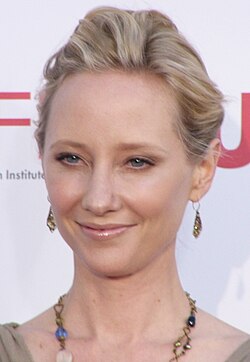
She wrote a poem as a little girl. She said she wished she was a movie star — someone who worked all day and never played. Her mother saved it. Years later, she gave it back to her daughter.Anne Heche read those words and felt something shift. “I think my career was predestined,” she said.What she didn’t write in that poem — what no child could possibly know — was everything she would have to survive to get there.Anne Celeste Heche was born on May 25, 1969, in Aurora, Ohio, the youngest of five children. Her father was a Baptist choir director and her mother a homemaker. The family was deeply religious, moved frequently, and lived for a time in an Amish community. From the outside, it looked like an ordinary conservative American childhood.Then, in 1983, when Anne was thirteen, her father died of AIDS.
He had kept his illness and his secrets hidden behind the walls of his faith until the very end.Three months after his death, Anne’s older brother was killed in a car crash.Thirteen years old. Father gone. Brother gone. Family broken open.The remaining Heches moved to New Jersey, then to Chicago, where Anne worked in a dinner theater to help support the family. A talent scout saw her in a school production, and her professional journey began.She was cast in the NBC soap opera Another World in 1987, playing twin sisters — one gentle, one fierce — with such precision that she won a Daytime Emmy Award in 1991. Hollywood took notice. By 1993 she was making films. By 1997, she was everywhere at once.That year alone, she appeared in Donnie Brasco opposite Al Pacino and Johnny Depp, Volcano opposite Tommy Lee Jones, I Know What You Did Last Summer, and Wag the Dog alongside Dustin Hoffman and Robert De Niro.
She was signed to star opposite Harrison Ford in Six Days Seven Nights. By every measure, she was one of the most in-demand actresses in Hollywood.And then she fell in love with Ellen DeGeneres.In 1997, Anne and Ellen — already one of the most recognizable faces in American comedy — began a relationship that became known as “the first gay supercouple.” America was not entirely ready. The industry certainly wasn’t. When Anne asked to bring Ellen to the premiere of Six Days Seven Nights, the studio pushed back hard. Whispers started. Almost overnight, the roles stopped coming.She starred in the film anyway. She walked the red carpet with Ellen anyway. She refused to pretend.“I’ve always kind of gone with my heart,” she once said. “I’m always honest, whether I’m in the limelight or not.”The relationship lasted three years. When it ended in 2000, Anne was publicly adrift and went through an intensely difficult period that required hospitalization.
She recovered. In 2001, she did something that required a different kind of courage: she published a memoir.Call Me Crazy was raw, specific, and unflinching — an honest reckoning with a childhood marked by loss, a career derailed by love, and a mind that had fought hard battles quietly for years. She published it anyway.She kept working. She married cameraman Coley Laffoon in 2001 and had a son, Homer, in 2002. She made her Broadway debut that same year. She divorced in 2009 — publicly and painfully, with a custody battle that played out in the media. Later that year, she had a second son, Atlas, with her partner James Tupper. She kept rebuilding, kept returning, and kept showing up for the work she had dreamed of since she was a little girl writing poems about movie stars.In the years before her death, she was still acting steadily — in television shows, films, and on Broadway, earning a Tony nomination. She was also writing a second memoir, titled Call Me Anne. She submitted the manuscript just before the end.On August 5, 2022, Anne Heche drove her car into a house in the Mar Vista neighborhood of Los Angeles at high speed.
The car burst into flames. She was pulled from the wreckage with severe burns and a catastrophic brain injury. She was fifty-three years old.On August 12, she was declared brain dead. On August 14, after her family arranged for organ donation, life support was disconnected.Her family released a statement: “Today we lost a bright light, a kind and most joyful soul, a loving mother, and a loyal friend. Her bravery for always standing in her truth, spreading her message of love and acceptance, will continue to have a lasting impact.”Call Me Anne was published posthumously in January 2023. She never got to hold it.Anne Heche’s story is not a comfortable one. It does not resolve cleanly or end with the recognition she deserved. She was a woman who carried an enormous amount from a very early age — and who, despite all of it, kept choosing honesty over safety, truth over image, and work over silence.She lost her father at thirteen. She lost her career for loving openly. She rebuilt herself more than once, and kept going each time the floor gave way beneath her.And somewhere, there is still that childhood poem about a little girl who wanted to work all day and never play.She got exactly that.