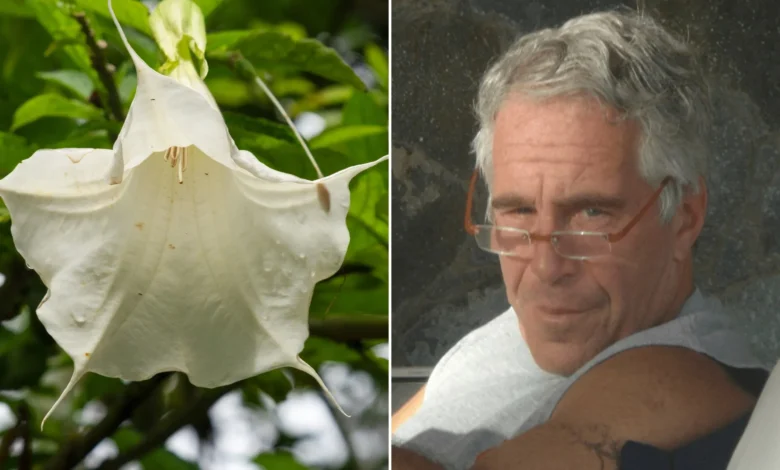
Recent reports from newly released documents in the Jeffrey Epstein files have brought attention to a particularly unsettling detail: Epstein’s apparent interest in and possible cultivation of highly toxic plants, including those known as Angel’s Trumpet—sometimes chillingly nicknamed the “Zombie Flower.”Scientifically classified under the genus Brugmansia, Angel’s Trumpet is a striking ornamental shrub or small tree prized for its large, pendulous, trumpet-shaped flowers that often bloom in shades of white, pink, yellow, or orange. These blooms release a strong, sweet fragrance especially at night, making the plant a popular choice for gardens in warmer climates. However, beneath its elegant and beautiful appearance lies a serious danger: every part of the plant—leaves, flowers, seeds, and stems—contains potent tropane alkaloids, primarily scopolamine, along with hyoscyamine and atropine.
These compounds are powerful anticholinergics that can produce profound and terrifying effects on the human body and mind when ingested, inhaled, or absorbed in sufficient quantities. Victims may experience intense hallucinations, extreme disorientation, delirium, amnesia, rapid heart rate, dry mouth, blurred vision, and in severe cases, complete loss of voluntary control, paralysis, coma, or even death. Scopolamine, in particular, has gained a notorious reputation in popular lore and crime reports—especially in places like Colombia—as “Devil’s Breath,” a substance allegedly capable of rendering people extremely suggestible, compliant, and zombie-like, stripping them of free will and memory while leaving them outwardly functional enough to follow instructions without resistance.
Emails uncovered in the Epstein files, dating back to 2014 and 2015, include references to “trumpet plants” in his nursery, with Epstein himself inquiring about their status (e.g., “ask chris about my trumpet plants at nursery?”). Additional correspondence forwarded to him highlighted scopolamine’s properties, including sensational claims that it “eliminates free will.” While some sources note that “trumpet plant” can refer to related species like Datura (Devil’s Trumpet), the context strongly points to Brugmansia due to its common association with scopolamine and ornamental cultivation.
This revelation adds yet another layer of intrigue and darkness to Epstein’s already deeply controversial life, characterized by secrecy, power, and allegations of manipulation and control. The idea that someone with his resources and connections might have grown such a plant—not merely as a decorative feature but potentially with awareness of its psychoactive and incapacitating potential—raises disturbing questions about intent and possibility. Although Angel’s Trumpet is legally grown worldwide as an exotic garden specimen, its extreme toxicity demands caution, and accidental poisonings (or worse) have been documented in medical literature for decades.The contrast is stark: a visually captivating plant with angelic-sounding name that conceals one of nature’s most mind-altering and dangerous natural chemicals. Its presence in a private collection serves as a grim reminder that beauty and peril can coexist in the same form, especially in the shadowy corners of wealth and influence.