Uncategorized

Nature’s Secret: 7,000-Year-Old ‘Spanish Stonehenge’ Rises from Underwater Tomb After 60 Years!
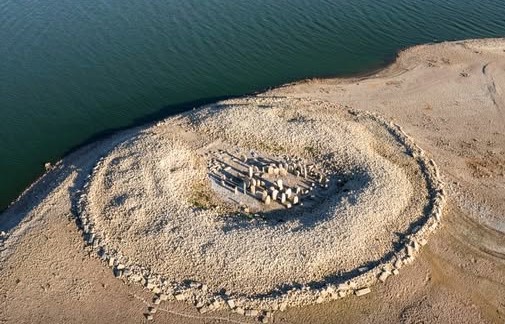
We often imagine that the greatest archaeological breakthroughs occur in far-flung exotic places, backed by huge budgets, advanced technology, and teams of experts on grand expeditions.But sometimes, nature itself steps in to uncover hidden chapters of our past in the most unexpected ways—no shovels, no funding required.A striking example is the Dolmen of Guadalperal, often called the “Spanish Stonehenge.” This ancient megalithic monument had been completely hidden from view for decades, submerged beneath the waters of the Valdecañas reservoir in western Spain’s Cáceres province.The site vanished underwater in 1963, when Francisco Franco’s regime constructed a dam to create the reservoir as part of a rural development project. For nearly 60 years, the stones lay silent beneath the surface, occasionally teasing with just their tips visible during drier summers—but never fully exposed.Then came the severe droughts that struck Europe, particularly in 2019 and again in 2022. As water levels in the reservoir plummeted dramatically (dropping to critically low percentages of capacity), the earth essentially parted ways to reveal what had been lost: a remarkable circle of around 150 granite megaliths, some standing over 6 feet (about 2 meters) tall, arranged in an oval or circular formation roughly 26 meters across.Believed to date back to around 5000 BC (or possibly as early as the 5th–4th millennium BC), this Neolithic structure is approximately 7,000 years old—making it roughly 2,000 years older than England’s famous Stonehenge and predating Egypt’s great pyramids as well. Archaeologists think it served multiple purposes: perhaps as a burial tomb, a ritual or ceremonial site, a temple, or even an ancient trading post or solar observatory, given its original strategic position near the Tagus River before the flooding.The drought didn’t just expose the stones—it reminded us how fragile and interconnected our history is with the environment. Erosion from prolonged submersion has damaged some of the granite and any remaining engravings, sparking calls from local groups and preservationists to relocate the monument to dry land for better protection and study. In 2022, Spain’s Ministry of Culture even declared it a Site of Cultural Interest to safeguard it from damage and vandalism amid growing tourist interest (including boat trips to view it when partially exposed).In a world obsessed with chasing the “next big discovery” through high-tech gadgets and massive investments, this story stands out: sometimes the past reveals itself when conditions force the present to pause. Nature, in its own unpredictable rhythm, decided the time was right to let us glimpse a piece of humanity’s ancient story once more—proving that history isn’t always buried deep; occasionally, it simply waits for the water to recede.
21 web pages