Uncategorized

Scientists Are Growing Real Human Brains in Labs to Power Computers – And They’re Already for Rent!
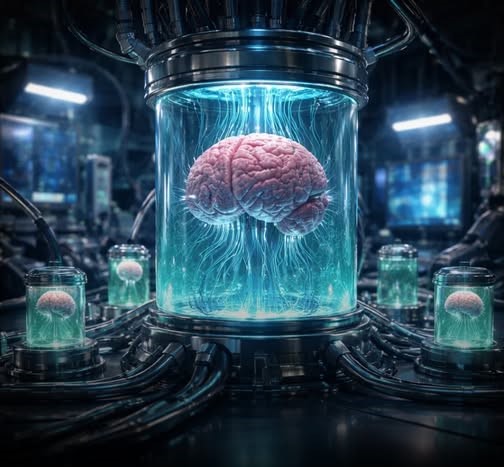
Researchers around the world are pushing the boundaries of biocomputing by experimenting with lab-grown brain organoids—miniature, three-dimensional clusters of human neurons cultivated from stem cells in controlled laboratory environments. These tiny structures, often just a few millimeters in diameter, self-organize into networks that form synaptic connections, exhibit electrical activity, and respond dynamically to stimuli such as electrical pulses or chemical signals.Popularly dubbed “living computers” or components of “organoid intelligence” (OI), these organoids are not miniature conscious brains or anything resembling full human cognition. Instead, they represent simplified, scalable models of neural tissue that recapitulate key aspects of brain function, including spontaneous firing patterns, plasticity (the ability to strengthen or weaken connections based on activity), and rudimentary forms of adaptation or “learning” in response to repeated inputs.
Pioneering efforts include companies like Cortical Labs in Australia, which in 2022 famously demonstrated that organoid-integrated systems could learn to play the classic video game Pong faster than some traditional AI approaches in certain metrics—though still far below human skill levels. More recently, the Swiss startup FinalSpark launched its Neuroplatform in 2025, a rentable remote-access system where researchers worldwide can interact with living human-brain organoids connected to electrodes and conventional computers. Users apply electrical stimulation and dopamine-like rewards to train the neural networks, aiming for ultra-efficient, low-energy computation that could one day rival or surpass silicon-based AI in sustainability—potentially using orders of magnitude less power than training massive models like those behind modern generative AI.Other notable advancements come from academic teams, such as those at Johns Hopkins University, who in 2025 reported that organoids display molecular and cellular building blocks essential for learning and memory processes. Institutions like UC Santa Cruz and international consortia (including NSF-funded projects under programs like BEGINOI) are developing benchmarks to test organoids’ real-time problem-solving, feedback response, and adaptive capabilities in closed-loop setups that link biological tissue directly to digital interfaces.
The core appeal lies in biological advantages: neural tissues process information in massively parallel, energy-efficient ways—consuming far less power per operation than traditional chips—while exhibiting inherent adaptability, noise tolerance, and continuous learning without needing retraining from scratch. Preliminary experiments show organoids can form goal-directed behaviors, recognize patterns, and adjust to changing stimuli, hinting at future applications in neuromorphic hardware, ultra-low-power AI, or hybrid bio-silicon systems.Yet the field remains firmly experimental and exploratory. Current organoids lack the complexity, scale, and organization of a real brain; they serve mostly as tools for studying neural development, disease mechanisms (e.g., Alzheimer’s or epilepsy models), drug screening, and basic neuroscience. True computational replacement of silicon chips is distant, requiring breakthroughs in longevity (organoids currently survive weeks to months), interfacing reliability, scalability, and output precision.
Ethical considerations loom large. Experts and bioethicists emphasize rigorous oversight to address moral questions: potential for unintended sentience-like properties (though widely considered implausible at current scales), consent around stem-cell sourcing, dual-use risks, and the philosophical implications of merging living human-derived tissue with machines. Frameworks are evolving to ensure responsible progress, with many researchers stressing that the primary focus today is biomedical insight rather than sci-fi-style cyborg computing.This convergence of stem-cell biology, electrophysiology, microfluidics, and AI signals an exciting—if cautiously approached—new frontier, where biology might inspire or even power the next generation of intelligent systems.Source/Credit: Insights drawn from recent reports by BBC (2025), Scientific American (2024-2025 updates), New Atlas, FinalSpark and Cortical Labs announcements, Johns Hopkins research (2025), Frontiers in Science, and related publications in Nature, STAT, and Wikipedia overviews on organoid intelligence and wetware computing (as of early 2026).