“He Killed His Parents at 16, Buried Them Behind the House, Then Escaped Prison and Lived as a Family Man for Over 50 Years”

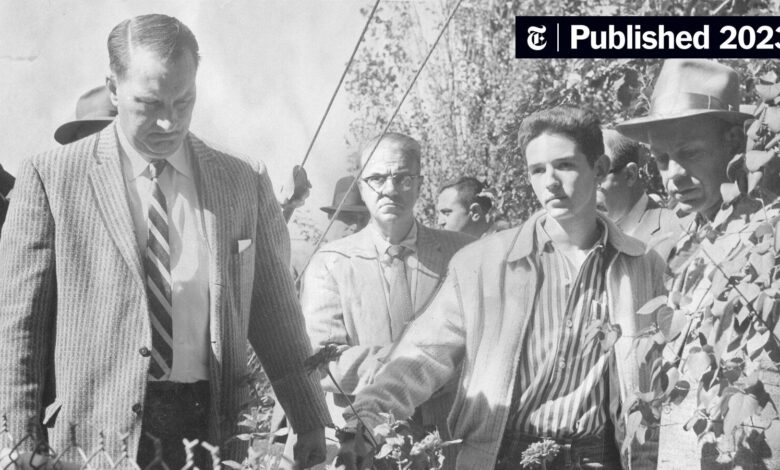
In the fall of 1958, in Omaha, Nebraska, a 16-year-old boy committed a shocking crime that would haunt investigators for decades. His name was William Leslie Arnold. In a fit of rage during a family argument, he shot and killed both of his parents. Instead of panicking or fleeing the scene, the teenager methodically hid their bodies overnight. The very next day, he dug two graves in the backyard of their family home, buried his mother and father, and then calmly returned to his normal teenage life as if nothing had happened.He continued going to school, spending time with friends, and acting like any ordinary high school student. When neighbors or teachers asked about his parents’ whereabouts, William simply shrugged and told them they were away on a trip.
For several weeks, his horrifying secret remained undetected.Eventually, when police began investigating the missing couple, the boy didn’t try to run or deny the crime. He confessed to the murders and led authorities directly to the backyard, showing them exactly where he had buried his parents. In 1959, William Leslie Arnold was convicted of two counts of second-degree murder and sentenced to life in prison at the Nebraska State Penitentiary. At the time, it seemed like a tragic but closed case of a troubled teenager who had snapped under pressure.But the story was far from over.In 1967, just eight years into his life sentence, William Arnold pulled off one of the most daring prison escapes in American history.
He and another inmate simply walked out of the Nebraska State Penitentiary and disappeared into thin air. While his escape partner was quickly recaptured, Arnold managed to vanish completely.What followed was one of the most successful long-term identity changes ever recorded in criminal history. Arnold made his way across the United States before eventually leaving the country entirely. He settled in Australia, where he assumed a new identity: John Vincent Damon.Under his new name, he built an entirely new and seemingly normal life. He got married, raised a family, and became known in his community as a reliable, friendly, and hardworking man.
Neighbors described him as a good husband, a loving father, and a quiet, decent person who enjoyed gardening and spending time with his family. For over five decades, no one ever suspected his dark past.William Leslie Arnold, now living as John Vincent Damon, died peacefully in Australia in 2010 at the age of 69, never having been caught or forced to answer for his crimes again.The truth only came to light years after his death. Family members submitted DNA samples for routine genealogical research. The results triggered a cold hit in a database, linking back to the unsolved 1958 double homicide in Nebraska. In 2023, authorities officially confirmed the incredible truth: the man known as John Vincent Damon had been William Leslie Arnold all along.The case left investigators and true-crime enthusiasts stunned.
A boy who murdered his parents at sixteen had successfully escaped prison, fled to another continent, reinvented himself completely, and lived freely for fifty-six years. He had married, raised children, grown old, and died without ever facing justice a second time.The story raises profound and unsettling questions. Was the violent teenager from Omaha the same person as the quiet grandfather in Australia? Did he carry the guilt of his crimes throughout his life, or did he truly become someone else? How was he able to integrate so seamlessly into normal society?William Arnold didn’t just escape prison — he erased his past and built a completely new existence. His case stands as a chilling reminder that some killers can hide in plain sight for a lifetime, living as ordinary people while their victims’ stories remain buried. Even today, the case continues to fascinate people as one of the most remarkable true crime stories of identity, escape, and long-term deception in modern history.