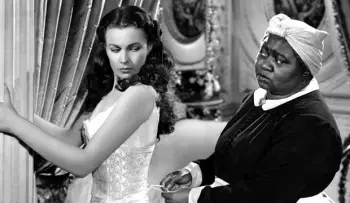
On the evening of February 29, 1940, Hattie McDaniel arrived at the glamorous Cocoanut Grove nightclub inside the Ambassador Hotel in Los Angeles, her hair elegantly adorned with white gardenias. The hotel had a strict “no Blacks” policy at the time, so producer David O. Selznick was forced to call in a personal favor just to get her through the front door. Once inside, she was not allowed to sit with her Gone With the Wind co-stars — Clark Gable, Vivien Leigh, and Olivia de Havilland — who were comfortably seated near the stage. Instead, Hattie was placed at a small, segregated table pushed against the far wall, far from the spotlight and the celebration.Then, her name was called.Best Supporting Actress.In that historic moment, Hattie McDaniel rose from her isolated table at the back of the room and walked slowly to the front — stepping not just across the ballroom floor, but into the pages of history.
She became the first Black person ever to win an Academy Award.Her acceptance speech was later described by famed Hollywood columnist Louella Parsons as “one of the finest speeches ever given on the Academy floor.” With grace and dignity, she thanked the Academy and expressed her heartfelt hope that she would always be “a credit to her race” and to the motion picture industry.After the applause, she quietly walked back to her lonely table against the wall.Who was this remarkable woman?Born to a father who had once been enslaved on a Virginia plantation and later fought as a Union soldier in the Civil War, and a mother who was a deeply religious singer, Hattie McDaniel showed extraordinary talent from a very young age.
She became one of the first Black women to sing on American radio, appeared in more than 300 films throughout her career, and had to fight fiercely to win the iconic role of Mammy in Gone With the Wind when hundreds of actresses competed for the part.When critics harshly attacked her for accepting roles as maids and servants, Hattie responded with simple, unapologetic honesty: “I’d rather play a maid than be one.”The contradictions in her life never seemed to end.She was not permitted to attend the grand premiere of Gone With the Wind in Atlanta because of segregation laws. After her groundbreaking Oscar win, her white co-stars went on to celebrate at exclusive clubs that still refused to allow her entry.
She managed to buy a beautiful home in Los Angeles, only to have white neighbors launch a campaign to force her out. She stood her ground, fought back legally, and ultimately won the right to stay.When she passed away in 1952, her final wish was to be buried at Hollywood Forever Cemetery, surrounded by the stars she had worked alongside for years. The cemetery refused her request because of her race. Instead, she was laid to rest at Angelus-Rosedale Cemetery. It was not until 1999 that a memorial marker was finally placed for her at Hollywood Forever.She had bequeathed her historic Oscar to Howard University, but it mysteriously went missing from the university in the 1970s.
The Academy finally presented a replacement Oscar to the university in 2023.For nearly 50 years after her victory, no other Black woman won a competitive Oscar — until Whoopi Goldberg’s win in 1991. In 2010, when Mo’Nique accepted her own Oscar for Precious, she paid direct tribute by wearing white gardenias in her hair and said emotionally: “Thank you… for enduring all that you had to, so that I would not have to.”In 2006, Hattie McDaniel became the first Black Oscar winner to be honored with a United States postage stamp.She was celebrated. She was excluded. She was honored. She was restricted.And through it all — through every barrier, every insult, and every moment of exclusion — she never stopped showing up.Hollywood was not always a credit to her. But she was always a credit to it.