Uncategorized

Your Dreams Are Literally Other Realities Your Brain Is Building Every Night – Science Just Proved It
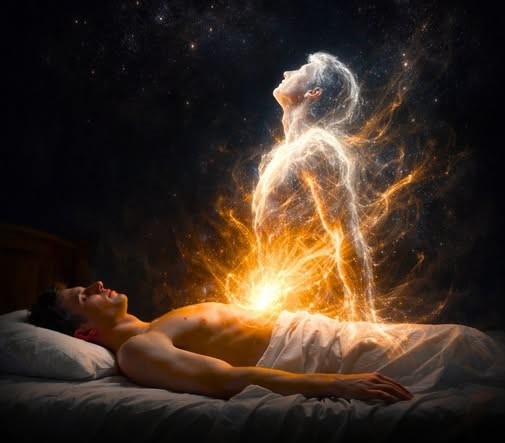
Recent neuroimaging and sleep research has revealed fascinating parallels between the dreaming mind during REM (rapid eye movement) sleep and waking consciousness. When we enter REM—the stage where most vivid, narrative dreams occur—the brain lights up in ways strikingly similar to when we’re awake and actively perceiving the world. Key regions involved in visual processing (like the high-order occipito-temporal visual cortex), emotional regulation (amygdala, anterior cingulate, insula), memory consolidation (hippocampus), and imaginative or creative functions show heightened activity levels comparable to—or in some cases approaching—those during alert wakefulness.
This neural overlap explains why dreams can feel intensely real and immersive: the brain isn’t just replaying random fragments; it’s dynamically generating full sensory experiences. Visual imagery is processed much like real perception, emotions surge with authentic intensity (often more raw or exaggerated than in waking life), and complex narratives unfold with internal logic, characters, environments, and even physics that feel consistent within the dream’s rules. The dreaming brain draws heavily on stored memories, subconscious associations, and imaginative capacities to construct these worlds “top-down”—internally generated rather than driven by external sensory input, which is largely gated off during sleep.
Some researchers and theorists describe this process as the brain running sophisticated simulated realities or virtual simulations. In theories like the threat simulation hypothesis or social simulation models, dreams serve adaptive purposes: rehearsing threats, practicing social interactions, processing emotions, consolidating memories, or exploring “what-if” scenarios without real-world consequences. These simulations can recreate alternate versions of events, decisions, relationships, or emotional states, allowing the mind to test outcomes, resolve conflicts, or prepare for future challenges. The result is a self-contained, internally consistent experiential world that feels as tangible and meaningful as waking reality—yet it’s entirely constructed from neural activity.
This has sparked intriguing philosophical discussions: dreams as “other realities” generated by the mind, offering glimpses into alternate possibilities or branched timelines within our own consciousness. However, mainstream neuroscience and physics draw a clear line here. While multiverse concepts (like the Many Worlds Interpretation of quantum mechanics) describe branching realities at the subatomic level, there’s no empirical evidence that dreams involve accessing or traveling to parallel physical universes. Dreams remain products of the sleeping brain’s biology—shaped by REM-specific neuromodulation (e.g., high acetylcholine, low aminergic activity), memory reactivation, and creative synthesis—rather than portals to external dimensions.
The enduring mystery lies in the sheer complexity and realism of these internal creations. During REM, the brain weaves intricate stories, evokes profound emotions, populates vivid scenes with familiar or bizarre elements, and even incorporates recent experiences or unresolved issues. In that immersive state, dreams are undeniably “real” as lived subjective experiences—fully constructed realities born from the interplay of perception-like networks, emotional centers, mnemonic traces, and boundless imagination. They highlight the brain’s extraordinary capacity to generate consciousness offline, blurring the line between internal simulation and felt reality, even as science grounds them firmly in neurophysiology rather than metaphysics. This blend of vivid authenticity and self-generated wonder continues to captivate researchers exploring consciousness, emotion, creativity, and the hidden functions of sleep.