Uncategorized

The Reagan-Era Iceberg That’s Finally Dying: 40 Years Adrift and Now Turning Blue Before Vanishing Forever!
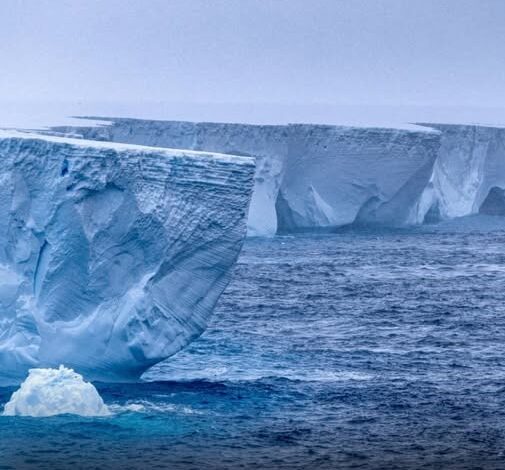
Iceberg A23a, once the world’s largest tracked iceberg, calved from Antarctica’s Filchner-Ronne Ice Shelf back in 1986—during Ronald Reagan’s presidency and the height of 1980s pop culture. This colossal tabular berg initially covered more than 3,900 square kilometers (about 1,500 square miles), roughly the size of Rhode Island or larger than many small countries, making it a record-holder for decades among monitored Antarctic icebergs.For much of its life, A23a remained relatively stable, often grounded on the seafloor in the Weddell Sea region, where it lingered for years without much movement. It finally broke free from that grounding around 2020, but its dramatic journey accelerated in late 2023 when strong ocean currents pushed it northward, away from cold Antarctic waters and toward the warmer expanses of the South Atlantic.By 2025, the berg had drifted past South Georgia Island, entering regions with higher sea temperatures that sped up melting and erosion. Satellite observations from NASA, the European Space Agency (ESA), and others captured repeated large-scale calving events throughout mid-to-late 2025, with sizable chunks—designated as new icebergs like A23G, A23H, A23I, and later A23J—breaking off in July, August, September, and even into early 2026. This fragmentation dramatically reduced its overall size and structural integrity.As warmer conditions took hold during the austral summer, vivid blue meltwater pools—often called “blue mush” by glaciologists—appeared across the surface. These pools form from internal thawing, where meltwater collects in depressions, absorbs more solar heat, and weakens the ice from within, accelerating breakup from both above and below. NASA’s MODIS instrument on the Aqua satellite documented extensive blue areas in late December 2025 and January 2026 images, signaling the berg was waterlogged and nearing collapse.
By early January 2026, the U.S. National Ice Center (USNIC) estimated A23a’s main body at around 1,182 square kilometers (456 square miles)—still larger than New York City but a fraction of its original extent. Further disintegration followed rapidly: timelapse satellite imagery from November 2025 through early February 2026 showed ongoing fragmentation, with the berg surrounded by ice mélange (a mix of smaller ice pieces) and debris.As of the most recent tracking data from the USNIC on February 6, 2026, the primary remnant of A23a measured approximately 26 by 22 nautical miles, covering about 163.54 square nautical miles (roughly 560 square kilometers or 216 square miles, though exact conversions vary slightly by source). Located around 49° 46′ S / 40° 16′ W, it continues to drift in the southern Atlantic, shedding pieces amid warmer waters often described as an “iceberg graveyard.”Scientists from NASA, the British Antarctic Survey, and other institutions note that complete disintegration appears imminent—likely within days to weeks from early 2026 observations—given the accelerated rate of loss and structural failure. While A23a no longer holds the title of the world’s largest (that distinction has passed to other bergs like parts of the D or B series), its remarkable 40-year odyssey underscores the impacts of ocean warming on Antarctic ice. Large, long-lived icebergs like this one highlight natural calving cycles but also serve as indicators of how shifting currents and rising temperatures can hasten the end for even the most resilient giants of the Southern Ocean.This epic finale closes an extraordinary chapter in polar science, reminding us of the dynamic, ever-changing nature of Earth’s cryosphere in a warming world