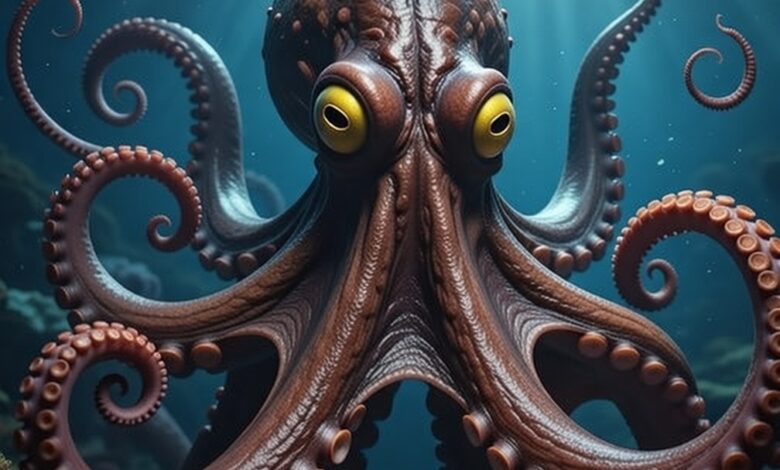
Scientists have put forward a captivating and somewhat mind-bending speculative scenario: should humanity one day vanish entirely from the face of the Earth, octopuses (along with certain other cephalopods) would rank among the most promising contenders to eventually give rise to the next truly intelligent, tool-manipulating, potentially civilization-forming lineage of life on our planet. This provocative hypothesis has been articulated with particular clarity by Tim Coulson, an evolutionary biologist and zoologist at Oxford University, who points to the suite of extraordinary biological and behavioral adaptations that make cephalopods stand out dramatically from nearly every other group of animals alive today.
Even at present, octopuses demonstrate levels of intelligence that are astonishing for invertebrates and that frequently rival or exceed the cognitive performance of many vertebrates in specific domains. They excel at solving intricate physical puzzles, they can learn new tasks rapidly through direct experience and sometimes by observing others, they display clear signs of playfulness and exploration for its own sake, and perhaps most impressively, they engage in genuine tool use. A well-documented case involves the coconut octopus (Amphioctopus marginatus), which deliberately gathers and transports two halves of a coconut shell across the seafloor, then assembles them into a protective shelter when resting—behavior that reveals not only object manipulation but also anticipation of future need and rudimentary planning. Their eight long, flexible, extraordinarily muscular arms—each studded with hundreds of independently controllable suckers—provide them with a degree of fine motor precision and versatility that is unmatched in the animal kingdom, allowing them to twist, turn, grasp, pull, push, and probe the environment with extraordinary dexterity.
One of the most remarkable aspects of octopus biology is their highly decentralized nervous system. Of the roughly half-billion neurons that compose an octopus’s nervous system, approximately two-thirds are distributed throughout the arms rather than concentrated in the central brain. This arrangement means that each arm can process tactile and chemical sensory information locally, initiate decisions, and coordinate complex movements largely on its own, almost as though the limbs possess a degree of autonomous intelligence. This distributed architecture underpins some of their most iconic behaviors: the ability to change color and texture instantaneously for near-perfect camouflage, the art of escaping from seemingly inescapable enclosures by identifying and exploiting tiny gaps, the precise handling and disassembly of objects, and even the use of rapid, dynamic skin displays to signal moods, intentions, or warnings to other octopuses during brief encounters. These capabilities reflect a form of intelligence that is profoundly alien compared to our own centralized, vertebrate-style cognition, yet it is undeniably powerful and adaptive.
In the wake of human extinction, many of the large land-dwelling mammals—including our closest primate relatives—would likely face substantial disadvantages. They often rely on the same resources, habitats, and ecological niches that humans heavily modified or dominated, leaving them vulnerable to the cascading environmental changes that might follow our disappearance. Octopuses and other cephalopods, by contrast, are already widespread across an immense variety of marine ecosystems: shallow sun-drenched coral reefs, rocky intertidal zones, seagrass beds, continental shelves, and even the cold, high-pressure darkness of the deep ocean. This ecological versatility and broad geographic distribution would likely confer greater resilience, more opportunities for population expansion, and a richer array of evolutionary pathways for descendant lineages over vast stretches of geological time.Other animals certainly exhibit impressive forms of intelligence. Certain birds (notably crows, ravens, and parrots) display exceptional problem-solving, memory, and even basic tool-making abilities. Some social insects show remarkable collective intelligence. Yet these groups typically lack the combination of traits needed to progress toward advanced tool cultures and technological civilization. Most crucially, they do not possess the highly versatile, multi-jointed, fine-scale manipulative appendages required to shape, combine, and refine materials into increasingly sophisticated objects and structures. Octopuses, with their soft, infinitely adaptable arms and their demonstrated capacity for precise object interaction, occupy a uniquely favorable position in this respect.
Beyond their physical capabilities, octopuses are naturally curious, highly exploratory, and quick to innovate when confronted with novel situations. In a future world entirely free of human pressures—overfishing, coastal development, plastic pollution, noise disturbance, and targeted hunting—natural selection would operate without these artificial constraints. Over many millions of years, evolutionary processes could plausibly favor lineages that live longer (thereby allowing more time for individual learning and skill refinement), that tolerate greater proximity to conspecifics (enabling rudimentary social learning and the transmission of useful behaviors), and that invest more heavily in cognitive flexibility and problem-solving. If these shifts occurred, it is conceivable that octopus descendants might eventually form stable groups capable of sharing knowledge across generations, constructing simple shelters or refuges, refining tool designs, and perhaps even developing forms of aquatic “culture” or proto-infrastructure adapted to life beneath the waves.
That said, formidable biological limitations currently stand in the way of such a trajectory. Nearly all octopus species are short-lived, with lifespans typically ranging from just one to five years, and females of many species die soon after laying and brooding their eggs. Moreover, the vast majority lead predominantly solitary lives, with only fleeting interactions during mating and no evidence of long-term social bonds or multi-generational teaching. These characteristics severely restrict the accumulation of cultural knowledge and technological progress, both of which depend heavily on prolonged lifespans and reliable mechanisms for passing learned information from one individual to the next.Nevertheless, evolutionary biology teaches us that seemingly insurmountable barriers can be surmounted across deep time when conditions favor particular traits. Given tens or even hundreds of millions of years, random mutations, natural selection, and changing environmental demands could potentially extend longevity, promote increased social tolerance or even cooperative behaviors, and enhance the cognitive and behavioral foundations necessary for collective intelligence and material culture. If these gradual transformations took place, it is not beyond the realm of possibility that the distant descendants of today’s octopuses could one day build complex underwater societies—marked by ingenuity, environmental manipulation, and perhaps forms of achievement that, while utterly different from our own, would be no less remarkable in their sophistication and creativity.
This speculative scenario serves as both a testament to the already exceptional nature of cephalopod intelligence and a humbling reminder that intelligence and civilization can arise along radically different evolutionary trajectories than the one we humans have followed.If you would like this version extended even further or modified in tone or emphasis, just let me know!