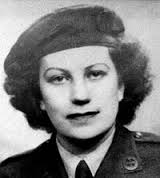
Her name was Eileen Nearne. Her nickname was “Didi.”Born in London to an English father and a Spanish mother, she grew up in France, where she became completely fluent in the language. When the Nazis invaded France in 1940, she and her sister Jacqueline managed to escape through Spain, Portugal, and Gibraltar, eventually reaching safety in London. The rest of her family remained behind in Grenoble.She could have lived out the war in relative safety in Britain. Instead, she volunteered for the Special Operations Executive — Britain’s highly secretive organization dedicated to sabotage, espionage, and supporting resistance movements across occupied Europe.
She specifically requested the most dangerous role available: that of a wireless operator in occupied Paris.She was warned that, with a bit of luck, her life expectancy in the field would be around six weeks. She accepted without hesitation.On the night of 2 March 1944, at the age of just 23, she was flown into France and landed by Lysander aircraft in a dark field. Her codename was Rose. Her cover story was that of a simple French shop girl named Mademoiselle du Tort.What followed were five months of intense, nerve-shredding survival in the heart of Nazi-occupied Paris.German detection vans equipped with radio direction-finding equipment could locate a transmitting radio in just minutes. Every single transmission was a deadly gamble against time. Despite the constant danger, over those five months Eileen sent 105 critical messages from Paris back to London. Her work helped coordinate vital weapons drops, financed resistance networks, and transmitted crucial intelligence about German troop movements and defenses.
One day, she went to a safe house to send an urgent message — directly against the orders of her chief. As she was finishing the transmission, she suddenly heard loud banging coming from the apartment next door. She quickly packed up her radio, hid the equipment, and destroyed her messages. Moments later, there was heavy thumping on her own door. When she opened it, she found herself staring down the barrel of a pistol held by a Gestapo officer.The Gestapo soon discovered her hidden radio set and coding pad.What followed was brutal torture.At Gestapo headquarters on the Rue des Saussaies in Paris, she endured the baignoire — the dreaded water torture, where she was held face-down in a cold bath and repeatedly submerged until she was on the verge of drowning. Her interrogators repeatedly called her a liar and pressed her for information. She never broke. She stuck firmly to her cover story throughout the ordeal.In August 1944, she was deported to Ravensbrück concentration camp. Her head was shaved, and she was told she would be shot if she refused to work. She initially refused anyway, but eventually realized that performing forced labor was the only realistic path to staying alive.While at the Torgau labor camp, she met fellow SOE agent Violette Szabo.
The two women planned an escape together, but Szabo was transferred before they could carry it out. Violette Szabo was later executed by the Nazis.On 13 April 1945, Eileen escaped with two French girls from a work gang. When they were stopped by SS troops, she calmly claimed they were French factory volunteers. The soldiers believed her and let them go. She eventually reached a sympathetic German priest who hid her until American forces arrived and liberated the area.She had survived far longer than the six weeks she had been given. She survived the five months of constant danger, the torture, the horrors of the concentration camp, and the desperate escape.When the war ended, she returned home to Britain — and then quietly disappeared from public view. She lived an ordinary, almost invisible life. Most people in her town had no idea about her extraordinary past.She gave only one interview in 1997 — appearing in disguise, speaking in French, and identifying herself only by her wartime codename “Rose.” She died of a heart attack on 2 September 2010 at the age of 89. Her body was not discovered for several days.
She had been heading for a pauper’s grave.Then council workers entered her small flat to search for next of kin. Inside, they found her medals, old documents, and photographs of two young women in British army uniforms.Word of her true identity quickly spread. Her funeral — paid for free of charge by a local funeral service — was attended by many strangers who had never known her in life. The eulogy was delivered by the Chairman of the Special Forces Club. As she had wished, her ashes were scattered at sea.Eileen Nearne was awarded the MBE and the French Croix de Guerre. Her citation praised her “cool efficiency, perseverance, and willingness to undergo any risk” in the service of freedom.