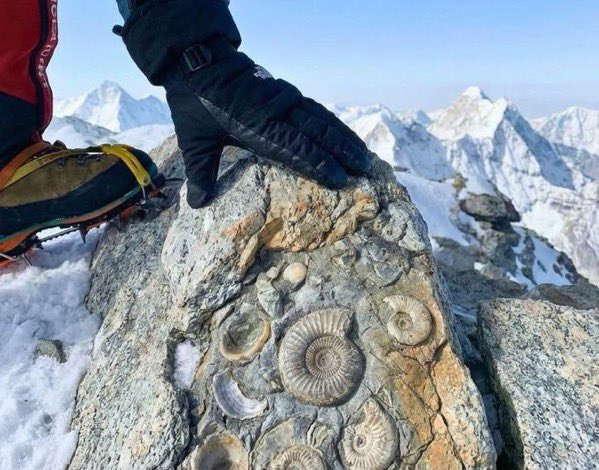
Here’s an expanded, more detailed, and engaging version of the text in English—keeping the original content and scientific facts intact while adding richer explanations, context, and flow for better readability:Imagine climbing to the roof of the world, standing at the summit of Mount Everest at 8,848 meters (29,029 feet) above sea level—the highest point on Earth—and discovering something completely unexpected: fossilized remains of ancient sea creatures embedded right in the rocks beneath your feet. Yes, marine fossils have been found in the limestone layers near the very top of Mount Everest, providing undeniable proof that this towering peak was once part of the ocean floor millions of years ago.
These remarkable fossils include trilobites (extinct, segmented marine arthropods that look a bit like underwater beetles), brachiopods (ancient shellfish with two shells that attached to the seafloor), crinoids (often called “sea lilies,” relatives of starfish with feathery arms), ostracods (tiny crustaceans), and even fragments of cephalopods and other invertebrates. Many of these date back to the Ordovician period, roughly 450–500 million years ago, though some related marine deposits in the broader Himalayas stretch to around 200–520 million years old.
They were preserved in sedimentary limestone rocks, particularly in formations like the Qomolangma Limestone (the gray summit rock) and the famous “Yellow Band” lower down.All of this happened because the region that is now the Himalayas was once submerged beneath the vast ancient Tethys Ocean—a warm, shallow tropical sea that separated the supercontinents of Gondwana (including the Indian landmass) and Laurasia (including Eurasia) for hundreds of millions of years. During that time, the seafloor accumulated layers of mud, shells, skeletons, and other organic debris from marine life. Over eons, these sediments compacted and hardened into limestone, trapping the fossils perfectly.
The dramatic transformation began around 50–55 million years ago, when the Indian tectonic plate—after breaking away from Gondwana and drifting northward at a relatively fast pace (geologically speaking)—slammed into the Eurasian plate. This massive continental collision didn’t just crumple the crust; it forced the dense oceanic floor of the closing Tethys Ocean upward in a process called orogeny (mountain building). Huge sheets of seafloor sediments were thrust, folded, and uplifted thousands of meters into the sky, creating the Himalayan mountain range and the vast Tibetan Plateau. The summit of Everest itself is made of these once-submerged marine limestones, pushed skyward by forces still active today.Incredible as it sounds, plate tectonics hasn’t stopped. The Indian plate continues to push northward into Eurasia at about 4–5 cm per year, causing Mount Everest (and the entire range) to rise roughly 4–10 millimeters annually, even as erosion slowly wears it down. This ongoing uplift is a direct result of the same collision that lifted those ancient ocean fossils to the top of the world.
Discoveries like these aren’t just cool trivia—they’re some of the most powerful real-world evidence supporting the theory of plate tectonics, first proposed in the early 20th century. They show us, in the most tangible way possible, how profoundly Earth’s surface can change over deep time: what was once a quiet seabed teeming with prehistoric marine life can become the planet’s highest mountain peaks. Mount Everest stands as a living (or rather, fossilized) testament to the slow, relentless drama of our dynamic planet—where oceans become summits, and time turns stone into sky.