Sold for $2,000 Like Junk — Then Beat the Triple Crown Winner TWICE and Built a Racing Dynasty!

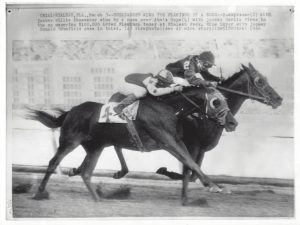
Nobody in the thoroughbred racing world gave Market Wise even the slightest chance. Sold not once but twice, dismissed as worthless, passed over by breeders and trainers, and essentially written off as a genetic dead-end, this unassuming chestnut colt from Virginia was supposed to fade quietly into obscurity — just another footnote in someone else’s pedigree page. What unfolded instead became one of the most astonishing Cinderella stories in American racing history, leaving the entire sport stunned, speechless, and forced to rewrite its assumptions about bloodlines, potential, and destiny.It all began with a pedigree that made experts cringe. His sire, Broker’s Tip, was notoriously unsound and fragile — a horse who managed to win exactly one race in his entire career.
That single victory, however, was the infamous 1933 Kentucky Derby, forever immortalized as the “Fighting Finish.” In that chaotic race, jockeys Don Meade (on Broker’s Tip) and Herb Fisher (on Head Play) engaged in an outrageous, on-track fistfight during the stretch run, grabbing saddle cloths and throwing punches while their mounts battled head-to-head to the wire. The stewards declared Broker’s Tip the winner, but the colt never won another race and retired with a reputation more for frailty than greatness.His dam, On Hand, was even less impressive. She started just once in her racing life, finishing a distant second in a minor event and earning a paltry $150 purse for her trouble. The breeding community looked at this mating and saw nothing but red flags: weak sire, one-start dam, no depth, no stamina, no class. Market Wise was dismissed before he even set foot on a track.Isabel Dodge Sloane, the prominent owner of Brookmeade Stable, apparently agreed. After the colt failed to win in his first six starts as a two-year-old in 1940 — including a humiliating drop into a low-level claiming race where he could have been purchased for a few thousand dollars — she bundled him together with another horse and sold the package to Louis Tufano for a grand total of $2,000. That’s right: two horses, including a supposed Derby prospect’s son, for less than the price of a decent used car in 1940. One can only imagine Sloane’s reaction years later when she realized what she had let slip away.Then came 1941, and everything changed. At three, under the patient handling of trainer George Odom and jockey Raymond Workman, Market Wise suddenly exploded. He captured the prestigious Wood Memorial Stakes at Jamaica Racetrack, a key prep for the classics. He shattered a long-standing track record in the Governor Bowie Handicap at Pimlico. He set another new American record in the Edgemere Handicap.
And then came the defining moment that shocked the racing world: in the grueling two-mile Jockey Club Gold Cup at Belmont Park, Market Wise outdueled and defeated the legendary Whirlaway — the same Whirlaway who had swept the Triple Crown earlier that spring (Kentucky Derby, Preakness, Belmont) and was being hailed as one of the greatest horses ever to race. Market Wise’s time set a new American record for the distance, proving it was no fluke.The rivalry continued into 1942. In the Suburban Handicap at Belmont, Market Wise did it again — beating Whirlaway once more in a thrilling stretch battle, cementing his status as one of the few horses ever to defeat a Triple Crown winner twice in major stakes.By 1943, the wear of an astonishing 53 lifetime starts was beginning to show. His legs and body had taken a pounding from years of hard campaigns against the best handicap horses in the country. Yet Market Wise refused to go quietly. In what would be his final race, the Narragansett Special, he dug deep one last time, surging to win by a gritty neck — only to pull up lame immediately after crossing the finish line. He retired on his own fierce terms, never having been beaten when truly fit and determined. That same year, he was honored as the 1943 Co-Champion Handicap Horse (shared with Devil Diver), a fitting capstone to an improbable career.Market Wise’s influence didn’t end with his retirement. As a stallion, he quietly built one of the most enduring female lines in modern racing. His daughter High Bid produced Bold Bidder, the 1966 Champion Handicap Horse and a top sire. Bold Bidder then sired the immortal Spectacular Bid — 1978 Horse of the Year as a two-year-old, 1979 three-year-old champion, 1980 Horse of the Year contender, Triple Crown near-miss, and eventual Hall of Famer.
Another daughter, Marking Time, produced Relaxing, the 1981 Champion Older Mare and 1989 Broodmare of the Year. Relaxing, in turn, produced Easy Goer — 1988 Champion Two-Year-Old Colt, 1989 Belmont Stakes winner, and one of the most brilliant and tragic colts of his generation.A horse literally given away for $2,000 — the equivalent of pocket change in racing terms — created a dynasty that still echoes through the record books and pedigrees today. Market Wise’s story is a powerful reminder that greatness isn’t always written in blue-blood pedigrees or million-dollar yearling prices. Sometimes it hides in the most unlikely places, waiting for the right trainer, the right jockey, and the right moment to prove everyone wrong.The next time someone tells you a horse (or a person) has “no future” because of where they came from, their bloodlines, or their early struggles, think of Market Wise. The numbers don’t lie. The record books don’t forget. And underdogs who refuse to quit can rewrite history.Who is your favorite overlooked champion or rags-to-riches story in racing history? Drop their name (and a quick why) in the comments below — we’d love to hear your picks and keep the conversation going! Expand on Spectacular Bid’s story