“Amazon Fungus Literally Eats Plastic & Turns It Into Nothing – The Solution to Pollution We’ve Been Waiting For?!”

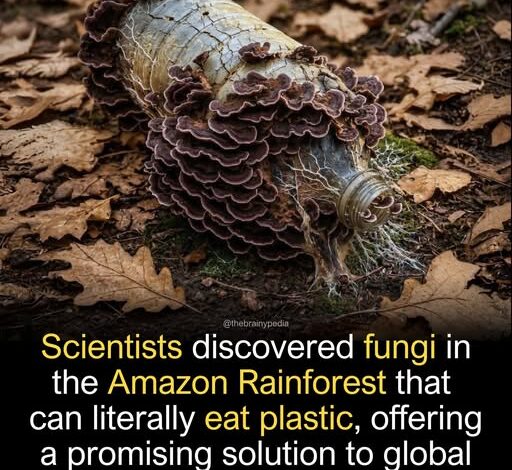
In a remarkable scientific breakthrough with far-reaching implications for the global plastic pollution crisis, researchers have identified a species of fungus thriving deep in the Amazon rainforest that possesses the extraordinary natural ability to consume plastic waste and transform it into harmless organic compounds.The discovery centers on the fungus Pestalotiopsis microspora, which was first isolated and studied by Yale University researchers during an expedition to Ecuador’s remote and biodiverse Yasuni National Forest—one of the most ecologically rich and pristine regions on Earth. What sets this particular fungus apart as truly exceptional is its capacity to thrive exclusively on polyurethane—a tough, widely used synthetic plastic found in everything from foam packaging and insulation to synthetic leather and coatings—as its sole source of nutrition.
Even more astonishing, Pestalotiopsis microspora can carry out this plastic-digesting process in completely oxygen-free (anaerobic) environments, conditions that mimic the oxygen-deprived layers often found in landfills, ocean sediments, or buried waste sites where traditional decomposition stalls almost entirely.According to detailed reporting by Earth Org, the fungus works by enzymatically breaking down the complex chemical bonds that give polyurethane its durable, long-lasting structure. Through this biological degradation process, the plastic is gradually dismantled at the molecular level and converted into simple, non-toxic organic matter—compounds that can be safely reabsorbed into natural ecosystems without leaving behind persistent pollutants or microplastics. This stands in stark contrast to conventional plastic recycling methods, which typically demand large-scale industrial facilities, high energy inputs, sorting infrastructure, chemical treatments, and significant logistical coordination. The fungal approach requires none of these artificial interventions; it operates quietly, efficiently, and sustainably using only the fungus’s own natural metabolic pathways.
The significance of this discovery cannot be overstated. Plastic pollution represents one of the planet’s most persistent environmental threats: conventional plastics can take hundreds—if not thousands—of years to break down naturally through physical weathering and UV exposure alone, meanwhile fragmenting into microplastics that infiltrate food chains, waterways, soil, and even human bodies. Landfills overflow with non-degrading waste, oceans accumulate massive garbage patches, and wildlife suffers widespread harm from ingestion and entanglement. By contrast, Pestalotiopsis microspora offers a biologically driven alternative that could dramatically accelerate decomposition timelines, potentially turning centuries-long pollution problems into processes measurable in months or years.Scientists view this fungal capability as a potential game-changer in the fight against plastic waste. If harnessed effectively—whether through large-scale bioremediation applications, controlled composting systems, or even engineered enhancements—these Amazonian fungi could help reduce the staggering volume of plastic accumulating in landfills, rivers, beaches, and marine environments worldwide.
The fact that the process works anaerobically opens exciting possibilities for tackling buried or submerged plastic waste that current technologies struggle to reach.This Yale-led finding from the heart of the Ecuadorian Amazon serves as a powerful reminder of how much untapped potential still exists within Earth’s biodiversity. In an era when human-made plastics seem nearly indestructible, nature has quietly evolved organisms like Pestalotiopsis microspora capable of dismantling them naturally and returning them to the cycle of life—offering a hopeful, organic pathway toward a cleaner, less polluted planet. Explain fungal enzymes mechanism