Eric Clapton Stopped Playing Mid-Solo When He Saw Her… A 16-Year-Old Deaf Girl Feeling Every Note

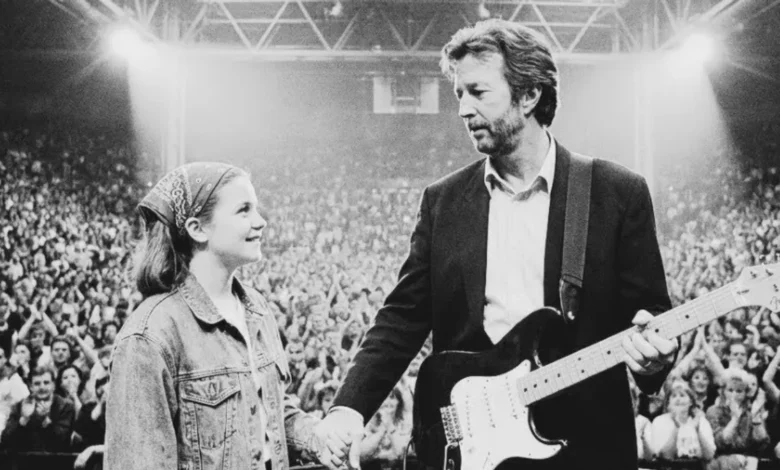
On September 23, 1992, in the packed National Indoor Arena in Birmingham, England, Eric Clapton was midway through one of his signature soaring guitar solos during “Layla.” The crowd of more than 12,000 fans was on its feet, roaring, singing along, lost in the familiar magic of one of rock’s greatest living legends at the peak of his powers.But in the third row, a 16-year-old girl named Sarah sat completely still.She wasn’t moving to the beat. She wasn’t clapping. She wasn’t even looking around at the frenzy around her. Sarah was profoundly deaf—she had been since birth—and she could not hear a single note of the music that had brought everyone else to their feet.Yet she was there anyway.
Yet she was there anyway.Sarah had come to the concert not because she could hear Eric Clapton, but because she refused to believe that music belonged only to those who could hear it. Over the years, she had taught herself to experience music in her own way. She studied videos of Clapton’s performances obsessively, memorizing every precise movement of his fingers across the fretboard, the way his hands shaped chords, the subtle shifts in his posture when he bent a note. She learned lyrics by watching lips move in grainy VHS recordings and live footage. Most importantly, she felt rhythm—not through her ears, but through her body: the deep thump of bass drums vibrating the floor, the pulse of subwoofers traveling up through the seats, the low-end resonance that made the air itself feel alive.
That night, surrounded by screaming fans, Sarah sat with both hands pressed flat against her chest, eyes closed, letting the powerful bass lines and kick drums reverberate directly into her ribcage. It was her private concert, one no one else in the arena could share.Then Eric Clapton saw her.In the middle of the solo, his eyes scanned the front rows—and locked onto the one person who wasn’t moving with the crowd. Something about her stillness, her focus, her complete absorption without sound, stopped him cold. He let the final note hang, then slowly lowered his guitar. The band, sensing the shift, fell silent. The roaring arena gradually hushed into an uneasy, puzzled quiet.Clapton stepped to the very edge of the stage, raised his arm, and pointed directly at Sarah.“Come here,” he said into the microphone, his voice soft but clear over the suddenly still PA system.Sarah didn’t react—she couldn’t hear the words. Her mother, sitting beside her, began signing frantically: He’s pointing at you! He wants you to come up!Confused, disbelieving, Sarah let her mother guide her forward. Security parted the crowd. She climbed the steps to the stage on trembling legs, unsure what was happening.When she reached Clapton, he knelt down to her level. He looked into her eyes and immediately understood—she was searching his lips, trying to read what he was saying. No words were needed for him to grasp that she was deaf.Without hesitation, he gestured for a roadie to bring a chair. He placed it dead center stage, right in front of his amplifiers. Then he turned to the sound engineer and signaled: Crank it up. Not the highs, not the mids—the lows. Make it deeper. Make it physical.He positioned his tallest stack of amplifiers directly behind the chair so the massive bass cabinets would push waves of vibration straight into Sarah’s back and through her entire body.Clapton turned to the silent, expectant crowd.“Ladies and gentlemen,” he said quietly, “this is Sarah. She can’t hear the music the way you do. But she feels it. She understands it better than most of us ever will.”And then he began to play—only for her.He didn’t play louder or faster to show off. He played slower, deeper, more deliberately.
Every note was chosen to maximize resonance: long, sustained bends that made the low-end throb, open chords that filled the air with rich overtones, slow slides that let the sustain ring through the stage floor. He locked eyes with Sarah the entire time, communicating not with words, but with intention.Sarah closed her eyes. Tears began to stream down her face as the music poured into her—not through her ears, but through every inch of her skin, her bones, her chest cavity. The vibrations traveled up her spine, pulsed in her fingertips, wrapped around her heart. For the first time in her life, she was experiencing a live performance created specifically for how she experienced the world.The 12,000 people in the arena didn’t cheer. They didn’t sing. They didn’t even whisper. They stood in reverent silence, witnessing something far more profound than a concert: a redefinition of what music actually is. Not just sound waves hitting eardrums. Music is vibration. It is connection. It is presence. It is one human being reaching another across whatever barriers exist.When the final note faded, Sarah opened her eyes. She was shaking.
Clapton gently took her hand, helped her stand, and walked her to the edge of the stage. As she made her way back down the steps and through the crowd, people reached out—not to grab, but to touch her lightly, reverently, as if she had become part of something sacred. She couldn’t hear their applause, but she felt it: the floor trembling, the air moving, thousands of hands clapping in unison like distant thunder rolling through her body.Sarah never heard a single note Eric Clapton played that night in the conventional sense.But she felt every single one.And in that moment, the greatest guitarist alive reminded an entire arena—and the world watching the footage later—that music isn’t confined to the ears. The purest listening happens in the soul, through presence, through shared humanity, through the simple, radical act of seeing someone and saying: I see you. This is for you.Sometimes the most powerful concert isn’t the loudest. It’s the quietest one ever played—for just one perso