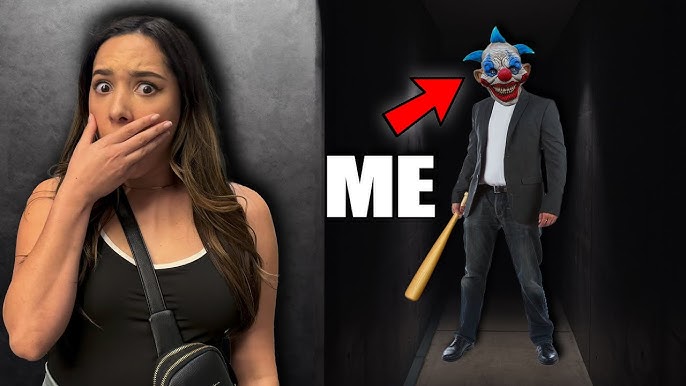
Here’s a longer, more detailed and engaging version of the text in English, expanded with extra context on the prank series, the specific incident’s play-by-play, social media buzz, debates on consent and safety, and broader implications for prank culture while keeping the original content and facts intact:A bold young woman has taken TikTok by storm with her daring street prank series, where she uses hidden cameras to ambush unsuspecting guys with elaborate, spooky setups designed to scare the living daylights out of them. Dressed in creepy costumes, jumping out from alleys with sudden screams, faking ghostly apparitions, or staging tense “stranger danger” scenarios in broad daylight, she captures raw, unfiltered reactions from men walking alone—everything from hilarious jumps and nervous laughter to wide-eyed panic and quick sprints away. Most encounters end on a lighthearted note: the guys quickly realize it’s a prank, share a laugh, exchange playful banter, high-fives, or even compliments on her creativity, turning potential awkwardness into viral gold. Her channel exploded in popularity thanks to these genuine, funny moments that showcase how differently people handle surprise frights in public.
But one particular video flipped the script and sent shockwaves through social media. In this standout clip, filmed on a busy urban street, she approaches a tall, serious-looking guy with her usual setup—perhaps a sudden shadowy figure emerging or a staged “haunted” encounter. Instead of the typical startled yelp followed by chuckles, the man freezes, then visibly tenses up. His face shifts from confusion to genuine anger as he realizes he’s being filmed and pranked without consent. Rather than laughing it off or walking away, he confronts her directly, voice raised, demanding to know why she’s targeting strangers and filming them. The situation escalates quickly: he grabs her phone (or the hidden camera setup), insists on seeing the footage, and—surprisingly—decides not to call the police or simply leave. Instead, in a bizarre and unexpected twist captured on the remaining footage, he tells her she’s coming with him “to sort this out properly” and ends up escorting (or essentially taking) her back to his nearby apartment or home to discuss boundaries, delete clips, or address the invasion of privacy face-to-face.
The full video, which she later posted (with parts blurred or edited for drama), racked up millions of views within days, igniting fierce debates across TikTok, Twitter/X, Instagram, and Reddit. Supporters of the prankster praised her for pushing creative content boundaries, calling her “fearless,” “hilarious,” and a master at capturing authentic human reactions in an age of scripted skits. They argued most guys took it well, proving pranks can be fun when harmless. Critics, however, found the guy’s intense response deeply unsettling—some worried about potential danger to the woman, questioning why she didn’t have better safety measures or backup, while others sided with him, slamming the prank as harassment, invasion of personal space, and a dangerous game that could provoke real aggression from the wrong person. Comments flooded in with phrases like “Pranks like this cross the line into creepy stalking,” “He had every right to be pissed—imagine being filmed without knowing,” “This is why consent matters even in ‘fun’ videos,” and “She got lucky he just took her home to talk instead of worse.”
The incident sparked wider conversations about the ethics of public pranking in 2026: Where exactly is the line between innocent humor and disrespect? How do surprise scares affect people with anxiety, past trauma, or bad days? Should creators get explicit permission before posting strangers’ faces online? And what responsibility do pranksters bear when a joke backfires and escalates? Despite the controversy—or perhaps because of it—the original prankster’s channel keeps growing, with new videos still dropping and viewers eagerly debating whether her bold style is genius entertainment or reckless risk-taking. In an era where every street moment can go viral, this one encounter serves as a stark reminder that not every scare lands as comedy—sometimes it uncovers real discomfort, anger, and the unpredictable ways people defend their personal boundaries.