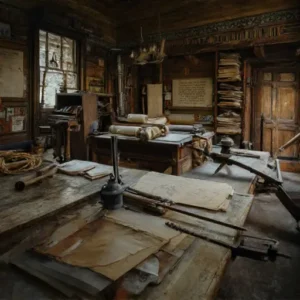
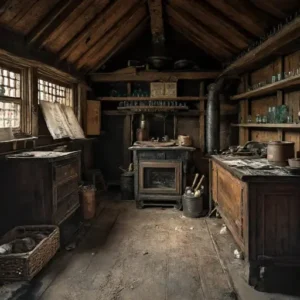
Edwin’s survey room stands frozen in time, a quiet monument to precision interrupted. Every surface tells part of the story: the careful order of tools, the half-finished maps, the fading notes that once guided a meticulous daily rhythm.His Notes and Methods
Edwin kept records with extraordinary care—handwritten entries detailing scale measurements, elevation figures, triangulation points, and precise geographic coordinates. A small folded slip tucked inside a ledger reads simply: “Thomas Whitfield – finish coastal chart Friday.” It suggests a well-structured routine: mornings spent measuring and plotting, afternoons annotating and correcting maps, evenings cleaning and calibrating instruments, all woven around the small domestic responsibilities of the household. Nothing was left to chance; every step was deliberate, documented, repeatable.
Edwin kept records with extraordinary care—handwritten entries detailing scale measurements, elevation figures, triangulation points, and precise geographic coordinates. A small folded slip tucked inside a ledger reads simply: “Thomas Whitfield – finish coastal chart Friday.” It suggests a well-structured routine: mornings spent measuring and plotting, afternoons annotating and correcting maps, evenings cleaning and calibrating instruments, all woven around the small domestic responsibilities of the household. Nothing was left to chance; every step was deliberate, documented, repeatable.
The Drafting Table and Instruments
At the center of the room, the main drafting table remains exactly as he left it. Several partially completed charts lie open, their inked contour lines trailing off abruptly at the paper’s edge. Compasses of varying sizes, straightedges, fine-nib pens, and dividers are arranged by function in neat rows. Beneath the open maps sits a thick ledger—pages filled with surveyed regions, coordinate adjustments, client specifications, and payment notes. Against the far wall lean a half-dozen unfinished coastal and topographic sheets, corners curling slightly from exposure, each one caught mid-creation, waiting for the steady hand that never returned.
At the center of the room, the main drafting table remains exactly as he left it. Several partially completed charts lie open, their inked contour lines trailing off abruptly at the paper’s edge. Compasses of varying sizes, straightedges, fine-nib pens, and dividers are arranged by function in neat rows. Beneath the open maps sits a thick ledger—pages filled with surveyed regions, coordinate adjustments, client specifications, and payment notes. Against the far wall lean a half-dozen unfinished coastal and topographic sheets, corners curling slightly from exposure, each one caught mid-creation, waiting for the steady hand that never returned.
Signs of a Mind Beginning to Falter
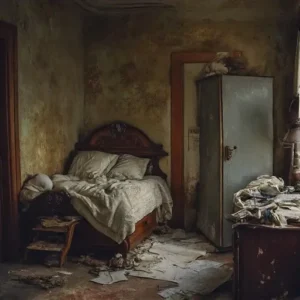
The later pages of the ledger tell a different story. Corrections appear more frequently—scale ratios crossed out and rewritten, orientations re-plotted, entire grid systems redrawn. Several maps show misaligned parallels and meridians; coastlines waver where they once ran crisp and confident. A smudged marginal note reads “client refuses final submission—rework entire NE quadrant.” Tools that were once obsessively aligned now lie scattered: one compass arm slightly bent, a ruling pen left uncapped and dried, ink pots tipped precariously. The once-unbroken rhythm of cartographic labor shows clear signs of strain—fatigue, perhaps illness, slowly eroding the exacting focus that had defined Edwin’s work for years.
The later pages of the ledger tell a different story. Corrections appear more frequently—scale ratios crossed out and rewritten, orientations re-plotted, entire grid systems redrawn. Several maps show misaligned parallels and meridians; coastlines waver where they once ran crisp and confident. A smudged marginal note reads “client refuses final submission—rework entire NE quadrant.” Tools that were once obsessively aligned now lie scattered: one compass arm slightly bent, a ruling pen left uncapped and dried, ink pots tipped precariously. The once-unbroken rhythm of cartographic labor shows clear signs of strain—fatigue, perhaps illness, slowly eroding the exacting focus that had defined Edwin’s work for years.
The Final Entry
In the deepest drawer of the survey cabinet lies Edwin’s last active map sheet. The coastline is complete up to a certain headland, then trails away into faint pencil lines and incomplete coordinates. A penciled reminder in the margin—“review projections with Thomas”—cuts off mid-sentence, the final word never written. No diary, no letter, no explanation survives to say why the work stopped so suddenly, or why Thomas Whitfield, the trusted apprentice, never came back to finish the remaining charts.The house has stood empty ever since. Dust settles on open ledgers. Ink fades on unfinished shores. Compasses rest where they fell. The entire room remains suspended—tools poised, maps half-drawn, coordinates forever pending—in silent testimony to a cartographer’s life work interrupted, a craft left mid-stroke, waiting for hands that will never return.It is not dramatic ruin, but something far quieter: the gentle, heartbreaking preservation of careful labor that time simply refused to let continue.
In the deepest drawer of the survey cabinet lies Edwin’s last active map sheet. The coastline is complete up to a certain headland, then trails away into faint pencil lines and incomplete coordinates. A penciled reminder in the margin—“review projections with Thomas”—cuts off mid-sentence, the final word never written. No diary, no letter, no explanation survives to say why the work stopped so suddenly, or why Thomas Whitfield, the trusted apprentice, never came back to finish the remaining charts.The house has stood empty ever since. Dust settles on open ledgers. Ink fades on unfinished shores. Compasses rest where they fell. The entire room remains suspended—tools poised, maps half-drawn, coordinates forever pending—in silent testimony to a cartographer’s life work interrupted, a craft left mid-stroke, waiting for hands that will never return.It is not dramatic ruin, but something far quieter: the gentle, heartbreaking preservation of careful labor that time simply refused to let continue.