Uncategorized

Sabrina Gonzalez Pasterski stands as one of the most remarkable and inspiring figures in contemporary theoretical physics—a brilliant mind whose journey from a Chicago garage to the forefront of quantum gravity research has earned her widespread admiration and frequent comparisons to legends like Albert Einstein.
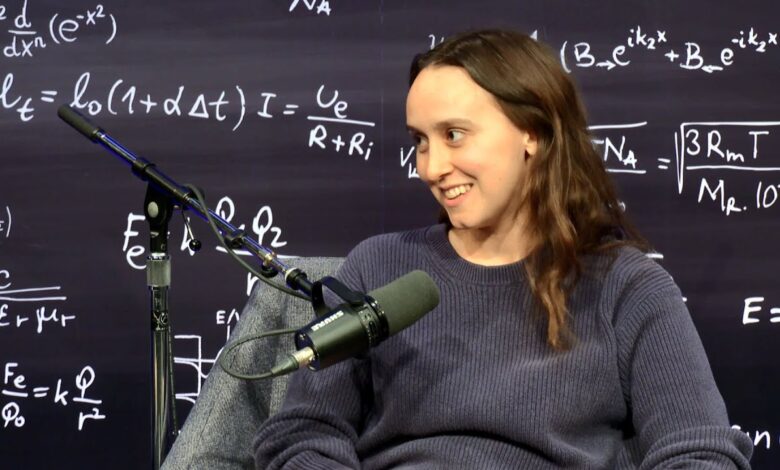
Sabrina Gonzalez Pasterski stands as one of the most remarkable and inspiring figures in contemporary theoretical physics—a brilliant mind whose journey from a Chicago garage to the forefront of quantum gravity research has earned her widespread admiration and frequent comparisons to legends like Albert Einstein.From her earliest days, Pasterski displayed an extraordinary blend of hands-on ingenuity and intellectual drive. As a teenager, she embarked on a project that would capture global attention: at age 14, she independently designed, constructed, and personally piloted her own single-engine airplane. Working meticulously over three years, she handled everything from sourcing parts and assembly to rigorous testing and documentation, ultimately taking to the skies in a machine she had built entirely by hand. This feat wasn’t just about aviation—it demonstrated her exceptional problem-solving skills, mechanical aptitude, and fearless determination to turn ambitious ideas into reality long before most people even consider such challenges.Her passion for understanding the universe soon shifted toward fundamental physics. Accepted into the Massachusetts Institute of Technology (MIT), Pasterski pursued a bachelor’s degree in physics with unmatched focus. She completed the program in just three years and graduated in 2014 at the top of her class with a flawless 5.0 GPA—a rare achievement in one of the world’s most competitive academic environments, and one that marked her as the first woman in decades to claim the number-one spot in MIT Physics. Her undergraduate success, bolstered by her homemade aircraft project, had already set her apart as a prodigy with real-world engineering prowess and deep theoretical insight.
Eager to dive deeper into the mysteries of gravity and spacetime, Pasterski moved on to Harvard University for her doctoral studies. There, she specialized in high-energy theoretical physics, tackling some of the most profound questions in modern science. During her graduate work, she made significant contributions to the study of gravitational wave memory effects. In collaboration with colleagues, she helped develop and explore the “spin memory effect”—a fascinating theoretical prediction about how rotating gravitational waves from events like black hole mergers could impart a permanent, detectable “twist” or imprint on the surrounding spacetime fabric. This subtle phenomenon expands our ability to probe cosmic events and test general relativity in new ways, potentially offering fresh observables beyond what current detectors capture.Her groundbreaking ideas quickly gained elite recognition. In 2016, the iconic physicist Stephen Hawking cited Pasterski’s research in his own work, an extraordinary endorsement that highlighted the originality and importance of her contributions while she was still in her early twenties. Being referenced by Hawking—one of the greatest minds in gravitational physics—catapulted her profile and affirmed her place among the field’s rising stars.Stories have long circulated online claiming Pasterski turned down a lucrative $1.1 million offer from Brown University (along with positions from NASA, Jeff Bezos at Blue Origin, and others) to prioritize pure research over financial or institutional prestige. While these anecdotes appear frequently in media profiles and reflect her well-documented pattern of choosing intellectual freedom and cutting-edge opportunities over more conventional paths, the exact details of specific offers remain variably reported and not always directly confirmed in primary sources.
After earning her PhD from Harvard in 2019, Pasterski completed a postdoctoral fellowship at Princeton University’s Center for Theoretical Science. In 2021, at just 27 years old, she joined the Perimeter Institute for Theoretical Physics in Canada as faculty—one of the world’s premier hubs for theoretical research—becoming one of its youngest members and helping diversify its ranks. There, she founded and now leads the Celestial Holography Initiative as principal investigator.
This ambitious program brings together experts in amplitudes, mathematical physics, and quantum gravity to investigate whether our three-dimensional universe (including gravity) can be fully described by a lower-dimensional, holographic theory encoded on a “celestial sphere” at infinity. Her work aims to bridge the long-standing divide between quantum mechanics and general relativity—one of physics’ greatest unsolved challenges—and continues to produce influential papers on symmetries, flat-space holography, and related frontiers.Beyond her research,
Pasterski maintains a low-key yet impactful presence, occasionally sharing insights through platforms like her website and emphasizing curiosity-driven science over fame. Her story—from rebuilding airplane engines as a child to leading initiatives that could redefine our understanding of reality—serves as a powerful testament to what happens when raw talent meets unwavering dedication. In an era of quick wins and distractions, Sabrina Gonzalez Pasterski reminds us that the deepest discoveries often come from those who quietly, relentlessly follow the questions that matter most, no matter where they lead.