Aliens 80 Million Light-Years Away Are Watching Dinosaurs Roam Earth RIGHT NOW – Mind Blown!

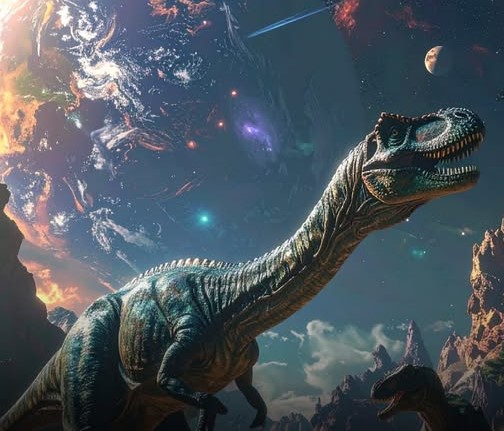
- Continental configuration was unlike today’s. The supercontinent Pangaea had long since broken apart. North America was split by the vast Western Interior Seaway, a shallow, warm inland sea stretching from the Gulf of Mexico to the Arctic Ocean, dividing the continent into eastern Appalachia and western Laramidia landmasses. South America and Africa were separating, India was drifting northward toward Asia, and Australia remained connected to Antarctica. Sea levels were significantly higher due to warmer climates and active seafloor spreading, flooding large continental shelves.
- Climate was generally warmer and more humid than today, with no permanent polar ice caps. Even the poles supported temperate forests rather than ice sheets. Global temperatures were elevated due to high greenhouse gas levels from volcanism and ocean circulation patterns, creating a greenhouse world where tropical and subtropical conditions extended far poleward.
- Landscapes featured lush, fern-dominated understories beneath towering conifers and the rapidly expanding angiosperms (flowering plants), which had begun diversifying explosively in the Cretaceous. Forests of magnolias, early figs, and other early flowering trees mixed with cycads, ginkgos, and conifers. Vast floodplains, river deltas, and coastal swamps teemed with life. Volcanic activity shaped some regions, while shallow epicontinental seas hosted rich marine ecosystems.
- Fauna was spectacularly diverse. Iconic tyrannosaurids like early relatives of Tyrannosaurus rex (which itself appeared around 85–68 million years ago) prowled as apex predators. Massive herds of hadrosaurs (duck-billed dinosaurs) such as Parasaurolophus, Edmontosaurus, or Shantungosaurus migrated across plains, grinding vegetation with batteries of teeth. Ceratopsians like Triceratops ancestors or centrosaurines charged with their elaborate frills and horns. Armored ankylosaurs and nodosaurs defended against attacks, while smaller theropods, ornithomimids, and dromaeosaurs (raptors) filled niche roles. Giant sauropods (titanosaurs) still roamed in some regions, though less dominant than in the Jurassic. In the skies, enormous pterosaurs like Quetzalcoatlus (with wingspans up to 10–11 meters) soared, and early birds coexisted. Oceans teemed with mosasaurs (up to 17 meters long), long-necked plesiosaurs like Elasmosaurus, giant sea turtles, ammonites, and sharks.
The aliens’ telescope feed would show no humans, no cities, no agriculture, no grasslands dominated by modern grasses (which exploded later), and no widespread modern mammal megafauna. Instead, they’d witness a world ruled by reptiles: herds of hadrosaurs trumpeting across floodplains, tyrannosaurs ambushing prey near rivers, pterosaurs gliding over coasts, and marine reptiles hunting in warm, shallow seas. Flowering plants were present but not yet as dominant in every ecosystem as they are now.This thought experiment highlights a profound truth about the universe: because of light’s finite speed, every distant observation is a historical record. For observers in galaxies millions or billions of light-years away, Earth might appear as a lifeless rock, a microbial world, or even prebiotic—depending on distance. Closer ones (say 100–200 million light-years) might still catch the aftermath of the dinosaur extinction or the rise of mammals. In a very real sense, the cosmos holds countless “live” views of our planet’s past, frozen in photons still en route.It’s a humbling reminder that what we call “now” is local—across the universe, time is stretched and layered by distance. If those 80-million-light-year-away aliens are watching right now, dinosaurs are still very much alive on their screens, oblivious to the asteroid doom still 14 million years in their future. Meanwhile, here on Earth in 2026, we’re the fleeting newcomers who arrived long after the light left.