Uncategorized

Tiny Nanobots Are Swimming Through Your Arteries to Blast Away Cholesterol – No Surgery Needed!
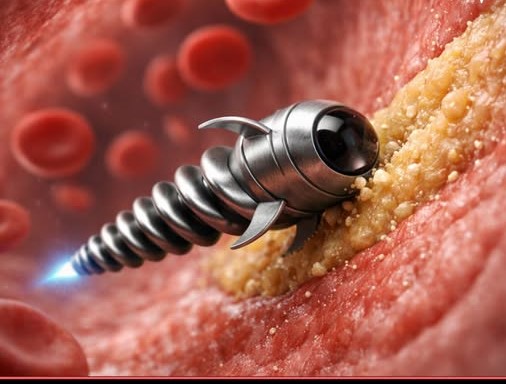
Researchers at Drexel University in Philadelphia have developed an innovative class of magnetic microswimmers—tiny, chain-like robotic devices roughly 200 nanometers in diameter (far smaller than the width of a human hair)—designed to one day clear atherosclerotic plaque from clogged arteries without traditional invasive surgery.These microswimmers consist of chains of biocompatible iron-oxide beads (magnetic nanoparticles) linked together chemically and magnetically. When subjected to a carefully modulated external rotating magnetic field, each bead spins in unison, causing the flexible chain to coil into a helical, corkscrew-like configuration. This bio-inspired propulsion—mimicking the flagellar swimming of certain bacteria—generates thrust, enabling the device to propel itself forward through flowing blood, steer precisely, and navigate even the narrowest, most curved, or branched blood vessels with remarkable control over speed, direction, and force.
The core therapeutic application: targeted disruption of cholesterol-rich atherosclerotic plaques that harden and narrow arteries, restricting blood flow and raising risks of heart attacks, strokes, and peripheral artery disease. Delivered via a minimally invasive catheter injection close to the affected site, the microswimmers would swarm or operate individually to mechanically loosen, fragment, and dislodge plaque buildup—acting like microscopic scrubbers or drills to restore lumen patency and improve circulation.To enhance safety and efficacy, the beads are engineered to be biodegradable. As they break down naturally in the body after their task, they can release payloads of anticoagulant medications (or other therapeutics) locally at the treatment zone—helping to dissolve or prevent acute blood clots (thrombosis) that might form during plaque disruption, while also reducing inflammation and inhibiting future plaque reformation.
This magnetically actuated, non-surgical paradigm offers clear advantages over conventional treatments such as balloon angioplasty with stent implantation, coronary artery bypass grafting (CABG), or surgical endarterectomy. Those methods often require incisions, large catheters, permanent implants, general anesthesia, and carry risks of vessel damage, embolism, infection, restenosis, and extended recovery. In contrast, the Drexel approach promises high-precision internal intervention with minimal trauma, potentially shorter procedures, reduced complication rates, and faster patient recovery.The technology originates from the Biological Actuation, Sensing & Transport (BAST) Lab led by Professor MinJun Kim in Drexel’s College of Engineering. Early work (demonstrated around 2015 and refined in subsequent years) included lab proofs-of-concept showing controlled swimming, chain reconfiguration (“transformer”-style linking and splitting), and propulsion in fluid environments simulating vascular conditions. It was part of broader international collaborations (e.g., with South Korea’s DGIST and funded initiatives) aiming for minimally invasive vascular procedures.As of early 2026, this remains firmly in the preclinical research and development stage—with demonstrations in artificial models and in vitro setups, but no progression to animal or human clinical trials reported. Ongoing challenges include achieving reliable swarm behavior for complex blockages, ensuring complete biodegradation without adverse effects, integrating real-time imaging (e.g., via magnetic particle contrast in MRI or ultrasound), scaling safe manufacturing, and validating long-term biocompatibility and efficacy in living systems.
Should these technical and regulatory hurdles be cleared, the microswimmers could transform cardiovascular care—enabling “from-the-inside” robotic therapies for widespread conditions like coronary artery disease, carotid stenosis, or peripheral vascular issues. This work sits at the exciting crossroads of nanotechnology, magnetic actuation, bio-inspired robotics, and interventional medicine, inching closer to a future where swarms of intelligent microscopic machines perform life-saving repairs deep within the body with unprecedented precision and gentleness.Source/Credit: Drexel University BAST Lab research (core demonstrations from 2015 publications in journals like Journal of Nanoparticle Research and Physical Review E), official Drexel news archives, Smithsonian Magazine (2015 feature), recent 2025 recirculations and viral social media summaries (e.g., Facebook, LinkedIn, Instagram posts framing it as a “2025 breakthrough”), YouTube explainers, and related coverage as of February 2026. While foundational concepts date to mid-2010s, renewed online interest has highlighted its enduring promise.