Uncategorized

Scientists Just “Printed” Living Tissue Inside the Body… Using SOUND Waves! (No Surgery Needed)
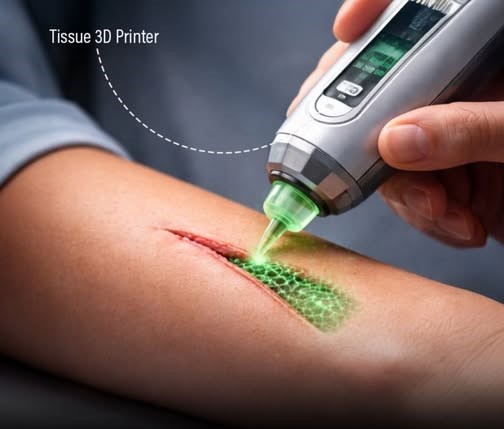
Researchers at the California Institute of Technology (Caltech) have pioneered an innovative technique known as Deep Tissue In Vivo Sound Printing (DISP). This method employs focused ultrasound to enable the precise assembly and solidification of materials, including soft structures, polymers, and potentially tissue-like constructs, directly inside the body—without the need for any surgical incisions.The process begins by injecting a specialized bioink composed of liposomes (tiny, temperature-sensitive vesicles) carrying polymer precursors or crosslinking agents. Once introduced into the body, researchers direct focused ultrasound waves to a specific target location. This raises the local temperature by just a few degrees—typically around 5°C—triggering the liposomes to release their contents. The released agents then initiate controlled polymerization, allowing the materials to form solid structures, such as polymer capsules, glue-like seals for internal wounds, or other customized patterns, exactly where needed.
What makes this approach particularly revolutionary is its non-invasive nature: ultrasound penetrates deep into tissues safely and precisely, guiding the “printing” process in real time. The technique also incorporates ultrasound imaging feedback, as the transforming materials change acoustic contrast, enabling scientists to monitor and adjust the assembly on the fly for high accuracy.In preclinical tests conducted on live animals, including mice and rabbits, the team successfully demonstrated applications like sealing internal injuries, delivering cells or drugs to precise sites, and creating localized bioelectric materials. These early results point to exciting possibilities for future medical interventions.
By eliminating the requirement for open surgery, this sound-guided internal engineering could dramatically reduce risks associated with traditional procedures—such as infections, prolonged recovery periods, excessive scarring, and overall physical trauma to the patient. It paves the way for minimally invasive or entirely non-invasive treatments that integrate therapeutic construction, healing support, and even embedded sensing capabilities within the body’s own environment.Although the technology remains in the research and development stage, with further studies needed to refine safety, scalability, and long-term biocompatibility for human use, it marks a significant leap forward. DISP represents a convergence of ultrasound physics, materials science, and biomedicine, bringing us closer to a future where complex internal repairs and enhancements can be achieved using nothing more than targeted sound waves—transforming ideas once limited to science fiction into tangible medical reality.
Source/Credit: California Institute of Technology (Caltech), with details drawn from their published work on in vivo sound printing (e.g., as reported in May 2025 announcements and related scientific coverage).