Blind People Could See Again: World’s First Brain-Implanted Bionic Eye Heads to Human Trials!

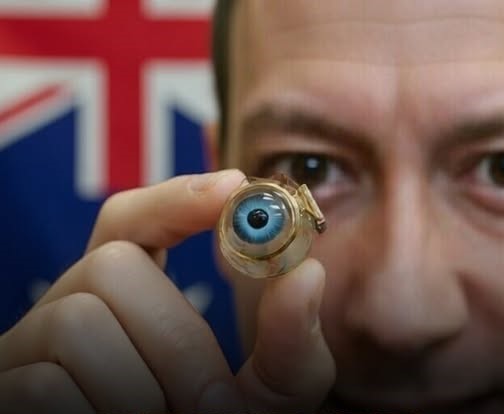
- A compact, wearable headset equipped with a miniature camera captures real-time scenes from the user’s environment.
- An external vision processor analyzes and converts these images into patterns of electrical stimulation.
- Wireless signals are transmitted to up to 9–11 tiny, fully implantable “tiles” (each about 9 mm square, containing hair-thin microelectrodes) placed directly on the surface of the visual cortex.
- These electrodes stimulate cortical neurons in precise patterns, evoking perceptions of light spots (phosphenes), basic shapes, motion, contrast, and spatial layout—creating a rudimentary but usable form of artificial vision.
Key technical highlights include:
- A wide ~100-degree field of view (far broader than many earlier bionic vision devices).
- Fully wireless, implantable design with no penetrating wires through the skull after implantation.
- Capability to support navigation, object detection, and obstacle avoidance in everyday settings, rather than just simple light perception.
The technology targets blindness caused by conditions where the retina or optic nerve is irreversibly damaged, such as:
- Severe retinitis pigmentosa,
- Advanced macular degeneration (in cases where retinal implants aren’t viable),
- Glaucoma with profound optic nerve loss,
- Traumatic eye injuries, or
- Other acquired or congenital causes of total blindness.
After more than a decade of development (initiated around 2010), the system achieved significant milestones in preclinical testing:
- Successful long-term implantation and safe stimulation in animal models (including sheep), with minimal adverse effects, stable performance, and effective elicitation of visual percepts.
As of early 2026, Gennaris has received Breakthrough Device designation from the U.S. FDA, accelerating regulatory pathways. The Monash Vision Group is actively pursuing funding and final preparations for first-in-human clinical trials in Melbourne, Australia. These world-first trials will involve a small cohort of participants with complete bilateral blindness to rigorously evaluate safety, device functionality, perceptual quality, and practical benefits (such as improved mobility and independence). Necessary ethical and regulatory approvals are in place or advancing, building on the promising animal data.While the restored vision is not high-resolution “natural” sight (users perceive a pixelated array of light patterns rather than photographic detail), it offers substantial functional gains—enabling better environmental awareness and quality of life compared to total blindness or older-generation devices.This project stands as a landmark in cortical neuroprosthetics and vision restoration, complementing retinal-based approaches (like Argus II) by addressing cases where the optic pathway is compromised. Success in upcoming human trials could pave the way for broader clinical application, potentially transforming the lives of millions worldwide affected by irreversible blindness.Disclaimer: This information is for educational and awareness purposes only. It does not constitute medical advice. Anyone considering vision restoration options should consult qualified ophthalmologists, neurologists, or neuro-ophthalmology specialists.Source/Credit: Monash Vision Group official site (monash.edu/bioniceye), Monash University news and research publications (up to 2025–2026 updates), FDA Breakthrough Device info, preclinical studies (e.g., sheep implantation results), and coverage from New Atlas, Medium technical overviews, Digital Watch Observatory (Dec 2024), CXO Content (Nov 2025), and related scientific announcements as of February 2026. Human trials remain in the preparation/funding-seeking phase—no participants implanted yet.
24 web pages