As individuals grow older, various interconnected brain networks that support essential functions—such as forming and retrieving memories, sustaining focused attention, regulating emotions, and coordinating complex behaviors—tend to gradually weaken and lose efficiency. This natural age-related decline can lead to reduced cognitive flexibility, slower processing speed, and a higher vulnerability to neurodegenerative changes over time.
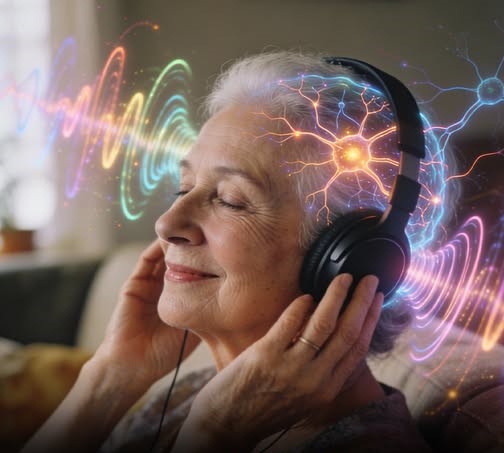
Music stands out as a powerful and multifaceted activity because it simultaneously engages and stimulates a remarkably broad array of these very networks. When a person listens to music, the auditory processing regions in the temporal lobes immediately activate to decode pitch, rhythm, timbre, and melody. At the same time, this information flows to and interacts with the hippocampus and other memory-related structures (helping recall associated events, lyrics, or emotions from past experiences), the limbic system and amygdala (triggering emotional responses ranging from joy to nostalgia), prefrontal areas involved in attention and executive control, and even motor-related regions in the basal ganglia and cerebellum (which can evoke subtle movements, tapping, or dancing even if the person remains still). This widespread, synchronized activation across distributed brain areas effectively “lights up” multiple neural circuits in a coordinated way.
By repeatedly recruiting these diverse pathways during music listening or performance, the brain maintains higher levels of activity and connectivity. This ongoing stimulation is believed to help preserve synaptic strength, promote neuroplasticity, and potentially delay or mitigate the progressive loss of neural connections and gray matter volume that commonly occurs with advancing age. In essence, music acts as a form of natural “brain exercise” that keeps these critical networks engaged and resilient.Supporting this idea, several large-scale longitudinal studies tracking thousands of older adults over many years have consistently observed a protective association between regular music engagement and lower dementia incidence. For example, individuals who reported listening to music on most days or frequently showed significantly reduced risks compared to those who engaged rarely or never. Playing a musical instrument appears to offer comparable—or in some cases complementary—advantages. This likely stems from the added demands of musicianship, which integrate sensory (hearing), motor (finger/hand coordination, breath control), cognitive (reading notation, timing, multitasking), and memory (recalling pieces or patterns) processes. These combined challenges provide repeated, intensive stimulation that fosters greater neural adaptability, strengthens inter-regional communication, and builds what researchers term “cognitive reserve”—a buffer that allows the brain to better withstand age-related changes or early pathological damage without immediate functional loss.
Beyond structural and connectivity benefits, music also elicits strong emotional reactions that trigger the release of beneficial neurochemicals, including dopamine (linked to motivation, reward, and pleasure), serotonin (supporting mood stability), and other signaling molecules involved in learning and neuroprotection. These chemical responses not only enhance the immediate experience but also contribute to long-term neuronal health by reducing stress-related inflammation, supporting synaptic maintenance, and reinforcing existing neural pathways through repeated positive reinforcement.Cumulatively, over months and years, this multi-level stimulation from music—structural, functional, emotional, and biochemical—may increase the brain’s overall resilience against the cumulative effects of aging, oxidative stress, vascular changes, and early neurodegenerative processes. While music is certainly not a cure or direct treatment for dementia or other forms of cognitive impairment, the accumulating evidence indicates that consistent, enjoyable engagement with music can serve as a meaningful contributor to brain health maintenance and cognitive resilience in later life.Importantly, one of the greatest strengths of music as a protective habit lies in its accessibility and appeal: it requires no special equipment beyond a radio, phone, or streaming service for listening, and it is inherently pleasurable for most people, making adherence far easier than many other lifestyle interventions. This simplicity and enjoyment increase the likelihood that older adults can incorporate it sustainably into daily routines, potentially yielding meaningful long-term benefits for cognitive well-being as they age.If you’d like this expanded further, shortened in places, or adjusted for tone, just let me know!