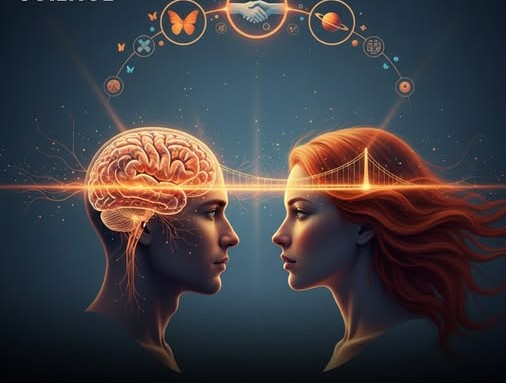
Telepathy, long confined to the realm of science fiction novels, movies, and comic books, has taken a dramatic step into real-world possibility. In a world-first demonstration, two volunteers equipped with non-invasive brain-computer interfaces (BCIs) successfully played a full game of 20 Questions—without uttering a single word, typing anything, or using any conventional communication method. One person thought of an object, and the other asked yes/no questions purely by imagining them. The answers were transmitted directly from one brain to the other across a distance of 50 miles. No voice. No text. Just thought-to-thought communication.This breakthrough marks a profound shift. What was once dismissed as impossible or purely speculative is now being achieved using existing, non-surgical technology. The participants wore EEG caps (electroencephalography headsets) that detected their brain activity patterns. Sophisticated algorithms decoded the intended questions and answers in real time, then relayed them via the internet to the receiving participant’s device, which stimulated their brain in a way that conveyed the information as an internal “feeling” or conscious understanding. The entire exchange happened silently, wirelessly, and over a significant physical distance.We are, quite literally, witnessing the earliest practical steps toward direct brain-to-brain communication in humans. Researchers are calling it a proof-of-concept for what could eventually become a form of “technological telepathy” or thought-based networking—sometimes referred to, half-jokingly, half-seriously, as the dawn of the “hive mind.”The implications are staggering. In the near future, this kind of technology could:
- Allow completely silent, instantaneous communication in high-noise environments (military operations, emergency response, deep-sea or space missions)
- Enable people with severe speech or motor impairments (locked-in syndrome, advanced ALS, severe stroke) to express thoughts and hold full conversations without any physical movement
- Transform collaborative work, education, and creative processes by allowing multiple people to share ideas, mental images, or sensory experiences directly
- Create new forms of social connection—friends or family “feeling” each other’s emotions or intentions in real time, even when continents apart
At the same time, this leap forward immediately raises some of the most serious ethical and privacy questions humanity has ever faced.If thoughts can be decoded and transmitted, how long before they can be intercepted, recorded, or read without consent? Who controls the data stream between brains? Could governments, corporations, or malicious actors gain access to private mental content? What happens when the boundary between “my thoughts” and “our shared network” starts to blur? Could direct brain linking influence free will, create groupthink on an unprecedented scale, or make individual privacy obsolete?Even in voluntary, consensual use, questions remain: How accurate must the decoding become before we trust it with intimate thoughts? What safeguards prevent misuse? And perhaps most unsettling of all—what does it mean for human identity if our innermost mental worlds are no longer truly ours alone?This experiment is still very early-stage—limited to simple yes/no exchanges, requiring focused training, and dependent on current-generation non-invasive hardware. True, fluid, rich telepathy (sharing complex memories, emotions, or visual imagery) is likely still years or decades away. But the direction is unmistakable. The wall between minds, which has stood for the entire history of our species, is beginning to crack.We are entering an era where communication may no longer require language, sound, or even physical proximity. Whether this becomes the next great liberation of human potential—or one of the greatest threats to personal autonomy—will depend on the choices we make now, while the technology is still young.The future of human connection is being rewritten in real time. And for the first time, it’s happening not through words, but through thought itself.