Uncategorized

A quantum computer recently completed a calculation in minutes that would take a classical supercomputer longer than the age of the universe to finish.
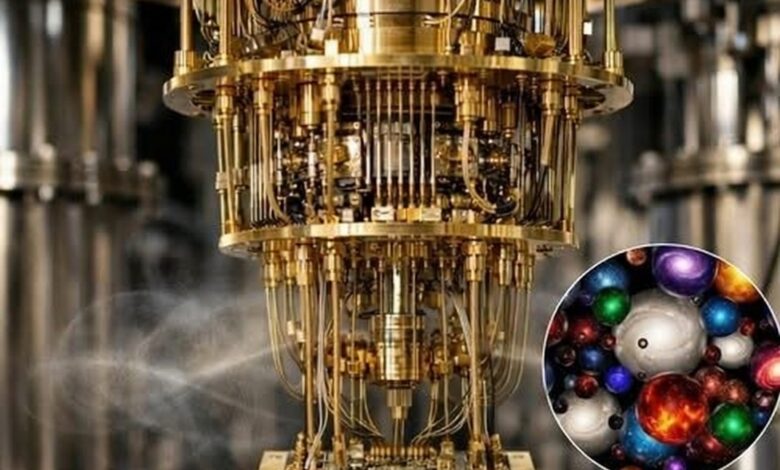
A quantum computer has just done something astonishing: it finished an extraordinarily complex calculation in only a few minutes — a task that the most powerful classical supercomputers on Earth would need longer than the entire age of the universe (roughly 13.8 billion years) to complete.This single result dramatically illustrates just how fundamentally different quantum computing is from every computer that has ever been built before it. Classical computers, no matter how fast or powerful, process information one step at a time, following a linear sequence of operations. Quantum computers, by contrast, harness two of nature’s strangest phenomena — superposition and quantum interference — to explore an enormous number of possible solutions simultaneously. In a single run, they can evaluate countless pathways at once and then interfere those pathways so that the correct answer emerges with extremely high probability.Some physicists have noted that this almost magical efficiency feels eerily similar to certain long-standing interpretations of quantum mechanics — most famously the Many-Worlds interpretation — in which every possible outcome of a quantum event actually happens in its own parallel reality. In that picture, the quantum computer isn’t really “calculating faster”; it is simply taking advantage of an immense number of parallel universes that are all computing different branches at the same time, and then the interference between those branches produces the final answer in our universe.Importantly, however, this does not mean the breakthrough proves the existence of parallel universes. The entire phenomenon can be explained perfectly well using standard quantum mechanics without ever invoking the multiverse as a literal, physical reality. The resemblance is striking and philosophically fascinating, but it remains an interpretation, not a proven fact.More than anything else, this achievement reveals how profoundly limited our everyday intuition about the quantum world really is. Concepts we take for granted — time, sequential processing, causality, even what “doing work” means — simply do not apply in the same way inside a quantum computer. The machine is not “thinking faster” in any classical sense; it is operating according to rules that our brains, evolved in a classical world, have almost no natural feel for.Whether or not parallel universes are real, one thing is already clear: quantum computers are forcing scientists to completely rethink the very meaning of computation itself. They are opening doors to problems we once believed would remain forever beyond reach — problems in chemistry, materials science, cryptography, optimization, and fundamental physics — and they are doing so not by being merely faster versions of today’s machines, but by exploiting an entirely different layer of reality.The age of classical computing gave us speed. The age of quantum computing is giving us something far more profound: a new understanding of what is even possible.