Uncategorized

A company that’s emerging as a strong competitor to established satellite internet providers like Starlink has taken a significant leap forward by successfully launching its largest and most advanced satellite to date.
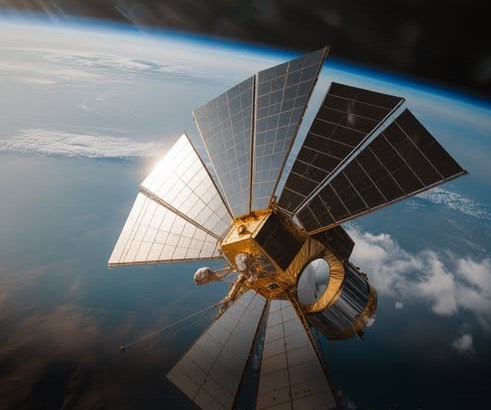
A company that’s emerging as a strong competitor to established satellite internet providers like Starlink has taken a significant leap forward by successfully launching its largest and most advanced satellite to date.
This milestone brings space-based cellular connectivity—designed to work directly with everyday smartphones—much closer to widespread, practical deployment.
The satellite in question, part of a next-generation series, functions essentially as a massive orbiting cell tower. It beams cellular signals straight down to standard, unmodified mobile phones, eliminating the need for bulky satellite dishes, special hardware, or adapters that users must carry.
This approach stands in contrast to traditional satellite broadband services, which typically require fixed ground terminals and are geared more toward home or business internet access rather than seamless integration with the phones people already own and use daily.What sets this new satellite apart is its sheer scale and capability.
It deploys an enormous phased-array antenna—spanning nearly 2,400 square feet once fully unfurled in orbit—making it the largest commercial communications array ever placed in low Earth orbit. This vast surface area dwarfs the company’s previous models (which were already impressive at around 693 square feet) and enables dramatically improved performance.
The larger array allows the satellite to illuminate much wider coverage areas on the ground, support higher data throughput, and manage connections for more users simultaneously. Advanced beam-forming technology lets it precisely direct signals toward specific regions or individual users, reducing interference, boosting signal strength, and delivering better voice call clarity, faster data speeds, and more reliable service even in challenging conditions
.The core ambition is straightforward yet transformative: to extend the familiar cellular network people rely on every day into the sky, creating a hybrid terrestrial-satellite system. In areas where traditional cell towers are impractical—such as vast rural landscapes, mountainous regions, remote islands, or developing countries with limited infrastructure—this orbital infrastructure could provide instant coverage without the enormous cost and time required to build thousands of ground-based towers.
During natural disasters, when terrestrial networks are damaged or overwhelmed, the satellite system could serve as a critical backup, keeping emergency communications alive. It also holds promise for bridging the digital divide in underserved parts of the world, where billions still lack reliable mobile broadband.While the technology has already demonstrated impressive results in earlier prototypes and initial production satellites—including successful direct connections for voice, text, and data to unmodified phones—the full vision requires a much larger constellation.
Continuous, global coverage demands dozens or even hundreds of these advanced satellites working together in coordinated orbits, ensuring that at least one is always overhead with a clear line of sight to users. The recent launch represents a crucial step in scaling up production and deployment, with plans for frequent follow-on missions to build out the network rapidly.
Challenges remain, including regulatory approvals for spectrum use across different countries, integration with existing mobile carriers, managing orbital congestion, and ensuring cost-effective service pricing. Nevertheless, this deployment underscores how quickly the field of space-based cellular networks is evolving from proof-of-concept experiments to real-world infrastructure. If the company achieves its goals, it could fundamentally alter global connectivity, making reliable mobile service truly ubiquitous and turning the sky into a seamless extension of the cellular grid we already depend on.